Before Farming: Pulse Cakes Inspired by Shanidar
ANCIENT MEALS · 007 / 100
Upper Palaeolithic Baradostian · Shanidar Cave, Iraqi Kurdistan · Approximately 40,000–33,000 BCE; dating remains under study
Evidence: archaeological reconstruction. The historical evidence and modern cooking choices are distinguished below.
A meal survives as a burnt fragment
There is no ancient name for the cakes on this page. Their starting point is an archaeological study of carbonised prepared plant food from Shanidar Cave in Iraqi Kurdistan. The peer-reviewed research identifies crushed pulse material, and some Upper Palaeolithic fragments contain mustard or tissues resembling Pistacia. The relevant layers date approximately 42,000–35,000 years ago, subject to the site’s ongoing dating work.
That is far earlier than farming and far earlier than a written recipe. The Birkbeck research account places the findings in the broader history of plant preparation. These traces challenge the habit of picturing prehistoric meals solely as meat. Their value lies in showing processing and combinations within surviving food fragments, rather than just listing seeds found somewhere nearby.
Evidence without a counterfeit recipe
The ancient fragment does not give a cake diameter, cooking time or ingredient proportion. Its original format could have differed considerably from our little patties. We therefore make a coarse cooked pulse mixture, add a restrained amount of commercial mustard seed and bake it into a manageable form. The recipe explores the identified food components and processing idea; it does not announce the discovery of a prehistoric pancake recipe.
Wild grass peas and vetches are not kitchen ingredients here. Commercial lentils and peas provide safe, accessible replacements; wheat flour helps the modern cakes hold together, and oil prevents sticking. Those binder and equipment choices are explicitly modern. We boil the pulses thoroughly before mashing rather than encouraging anyone to reproduce uncertain prehistoric detoxification methods or to forage unfamiliar seeds.
The useful contrast is coarse and fine
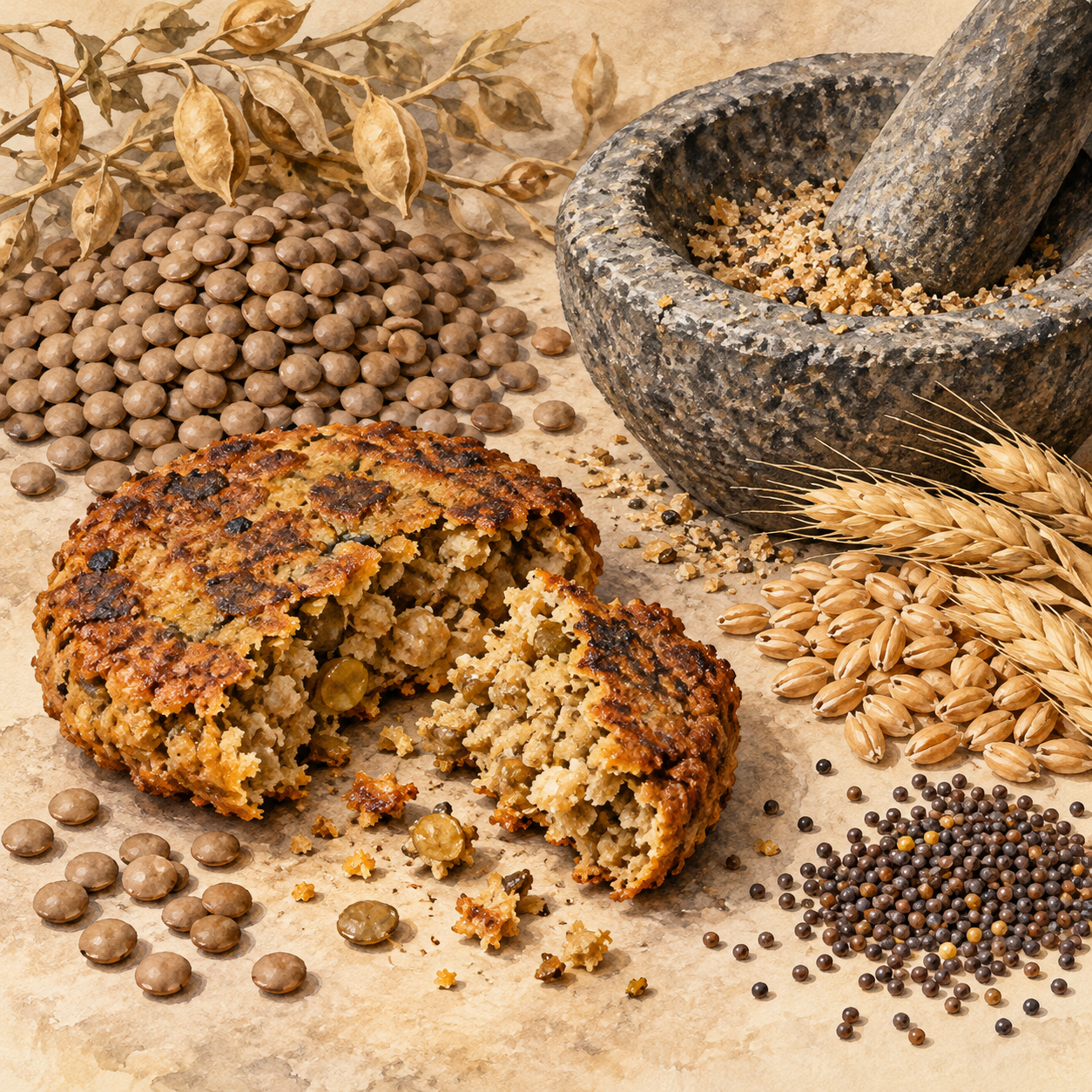
Leave part of the mixture visibly coarse. A smooth puree would conceal the difference between grinding everything into flour and pounding softened seeds so fragments remain. That distinction connects the cooking exercise to the archaeological interpretation. A mortar is optional: a fork or potato masher makes the same modern task easier. The illustrated ingredient study is generated, not an image of the studied fragments.
Serve the cakes warm as a small meal or side, with plain water and no elaborate modern sauce required. Make a test patty first; if it will not hold, add a little more flour to the mixture. The history is not a story of one unchanged dish travelling through forty millennia. It is the more surprising evidence that people prepared varied plant foods long before fields, granaries and recipe tablets existed.
Coarse lentil, pea and mustard cakes
Serves 4 · Preparation 20 min · Cooking 55 min · None
A modern adaptation for home cooking. Times are approximate.
Ingredients
- 120 g dry brown lentils
- 120 g dry split peas
- 900 ml water, plus extra for boiling
- 60 g wholemeal wheat flour
- ½ tsp commercial mustard seeds, crushed
- 2 tbsp olive oil
- ½ tsp salt
Method
- Rinse lentils and split peas. Boil in ample water, then simmer 35–45 minutes until both are fully soft. Drain very well.
- Heat oven to 200°C/390°F. Mash pulses coarsely, retaining some visible fragments.
- Mix with flour, mustard, 1 tbsp oil and salt. If wet, let stand 10 minutes, then add up to 1 tbsp extra flour.
- Shape eight patties about 1 cm thick. Place on a lined tray, brush with remaining oil and bake 20–25 minutes, turning once.
- Serve when firm, hot and cooked through; they will be more delicate than modern meat patties.
Substitutions and adjustments
- Use only lentils if split peas are unavailable; the substitution is modern.
- Omit mustard for an allergy, changing the flavour experiment.
Historical choices: Archaeological reconstruction inspired by processed pulse and mustard remains. Lentils, cultivated peas, flour binder, patty shape and oven method are modern choices.
Kitchen note: Use commercial edible pulses; never substitute wild vetch or grass pea. Cook pulses and flour fully.
Sources and further reading
- Kabukcu et al., Cooking in caves. Direct microscopic study of processed food; no proportions or shape survive.
- Birkbeck: prehistoric cooking research. Research-team summary of the findings and their significance.


Comments
Post a Comment