Sunflower Seeds Before a Maize-Centered Menu
ANCIENT MEALS · 093 / 100
Late Archaic Eastern Agricultural Complex · Interior eastern North America · c. 2500–1000 BCE
Evidence: archaeological reconstruction. The historical evidence and modern cooking choices are distinguished below.
A local crop history
Eastern North American communities developed food production using local seed plants. Sunflower belongs to that history, along with squash and other crops that are less familiar in modern supermarkets. Bruce Smith's reassessment of sunflower domestication examines archaeological kernels and achenes and the difficulties caused by carbonization and comparisons with wild plants. A large seed is evidence to investigate, not a simple universal threshold.
Research synthesizing eastern North American domestication places sunflower within a regional crop complex. This makes a useful correction to food histories that begin and end with maize, beans, and squash. Different Indigenous communities cultivated different resources at different times; a later familiar three-crop story cannot be applied automatically to this earlier setting.
A seed-rich food, not a cereal substitute
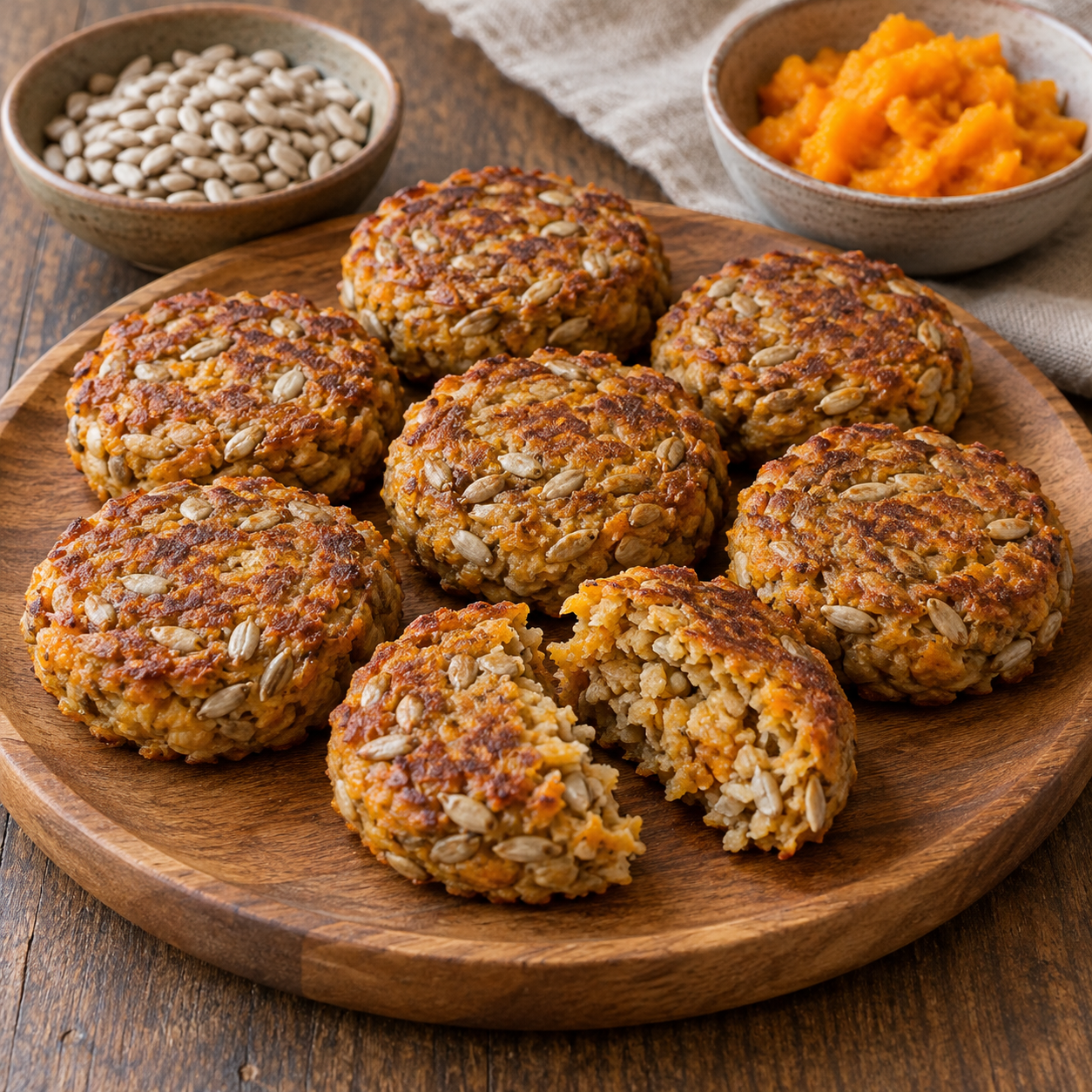
Our cakes combine finely ground sunflower kernels with cooked squash. They contain no wheat or maize flour. The squash supplies moisture and starch, while seed meal gives richness and most of the body. Baking sets small portions with a soft center and a firmer surface. The recipe is reconstructed; the seed-and-squash mixture was not recovered as an intact ancient cake in the cited research.
Commercial hulled seeds remove a substantial processing task. Ancient kernels needed to be separated from their coverings and prepared for eating. Grinding creates a very different texture from scattering whole seeds over a finished dish. Here, the seed is the substance of the preparation rather than a garnish. Modern neutral oil on the tray is simply a handling aid.
Do not replace one stereotype with another
Recognizing an indigenous agricultural center does not mean everyone stopped gathering or hunting when a few crops entered cultivation. Food production can vary in intensity and coexist with other livelihoods. The archaeological seed record helps us see particular changes without supplying an exact household timetable or a standardized recipe.
Serve two cakes per person and show the broken interior. The historical anchor is the region's seed-crop and squash resources; grinding degree, mixture, portion size, oil, and oven method are our interpretation. Their dense, savory texture distinguishes them from modern sweet sunflower cookies and from cereal pancakes. The food is a practical companion to a local crop story that deserves to stand beside, rather than disappear beneath, the better-known agricultural histories of other continents.
Sunflower-kernel and squash cakes
Serves 4 · Preparation 20 min · Cooking 30 min · 10 minutes cooling
A modern adaptation for home cooking. Times are approximate.
Ingredients
- 220 g hulled commercial sunflower kernels
- 250 g plain fully cooked winter-squash flesh, drained and mashed
- 3 g salt
- 10 ml neutral cooking oil for brushing tray
Method
- Heat oven to 190°C. Line and lightly oil a tray.
- Pulse sunflower kernels to a coarse flour, stopping before they become butter.
- Mix seed meal with squash and salt. If loose, add 20 g more ground sunflower kernels; if dry, add water a teaspoon at a time.
- Shape eight patties about 1 cm thick on the tray. Bake 25–30 minutes, turning gently once, until surfaces are lightly browned and centers are hot and set.
- Cool 10 minutes to firm before serving.
Substitutions and adjustments
- Use unsalted commercial sunflower meal if available.
- Use plain cooked pumpkin flesh rather than sweetened pumpkin pie filling.
Historical choices: Sunflower and squash belong to the regional ancient crop complex; the blended cake format and baking proportions are reconstructed.
Kitchen note: Use food-safe commercial ingredients.
Sources and further reading
- Smith, Domestication of Helianthus annuus. Smithsonian-hosted primary study of early sunflower evidence and identification problems.
- Smith, Eastern North America as an independent domestication center. Regional archaeological and genetic synthesis; no sunflower-squash cake recipe.


Comments
Post a Comment