Punic Porridge: Grain, Fresh Cheese, Honey, and Egg
ANCIENT MEALS · 039 / 100
Roman Republic · Italian peninsula · Approximately 160 BCE
Evidence: adapted surviving recipe. The historical evidence and modern cooking choices are distinguished below.
A name is not a passport
Cato calls this dish Punic porridge. The name invites a story about Carthage and the western Mediterranean, but the surviving evidence needs a narrower claim. We possess a Roman author's written instruction, not a Carthaginian household notebook. In On Agriculture 85, softened groats are combined with fresh cheese, honey, and an egg and transferred to a new pot. The adjective is evidence of how Cato named the preparation; it does not prove that our finished bowl reproduces a meal eaten throughout Punic North Africa.
The mixture is strikingly rich compared with a plain grain gruel. Cheese outweighs the dry grain in the ancient proportions, and honey provides sweetness without modern sugar. The egg introduces another uncertainty because the brief directions do not spell out the final heat treatment. The recipe heading presents a cooking instruction, yet the passage stops after putting the mixture into a pot. A responsible modern cook must complete that step explicitly.
Reconstructing the missing finish
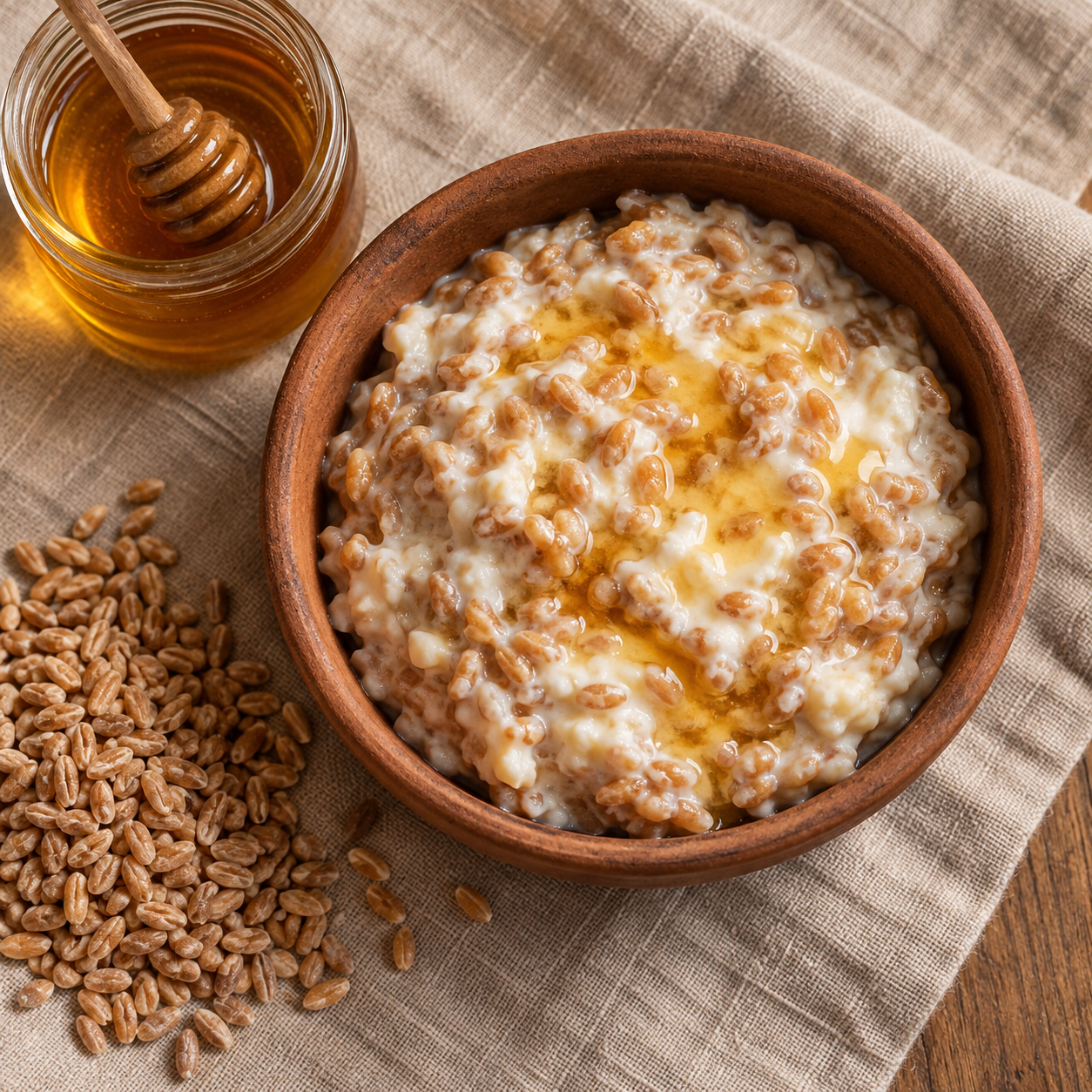
Here, pearled farro is cooked until very tender before cheese and egg are added. Farro is a modern retail category that may encompass different hulled wheats, so it is a useful grain choice rather than a perfect species identification. The egg is tempered with hot porridge and then gently heated through. This produces a warm, spoonable grain-and-cheese dish, distinct from baked savillum and fried globi. It also avoids treating Cato's silence as permission to serve an uncooked egg mixture.
The introduction to Cato's agricultural work explains the historical setting of a text associated with Republican Italy and transmitted by later manuscript traditions. Cato's cultural labels and preferences are part of that setting. They should be read critically, particularly when modern enthusiasm turns one named recipe into an entire national cuisine. What can be retained with confidence is the ingredient relationship and the sequence of softening grain before adding the other foods.
Eating the adaptation
The result is intended as a modest sweet bowl, not a drink and not a smooth custard. Soft grains remain visible within the cheese. Honey can be adjusted at the table, but cinnamon, fruit, and nuts are omitted so that the recorded combination remains clear. Drain the cheese well, and add water as needed to keep the grain from scorching. Quantities, cooking times, and the final safety temperature are modern adaptations. Watch texture as well as time.
Warm Punic-style grain and cheese porridge
Serves 4 small bowls · Preparation 10 min · Cooking 40 min · None; longer if using whole unpearled grain.
A modern adaptation for home cooking. Times are approximate.
Ingredients
- 120 g pearled farro, rinsed
- 600 ml water, plus extra as needed
- 300 g pasteurized ricotta, drained
- 50 g honey
- 1 large egg, beaten
Method
- Simmer farro in the water for 25–35 minutes until very soft, adding water if needed so it remains a loose porridge.
- Mash ricotta with honey in a bowl. Stir into the cooked grain over low heat.
- Put the beaten egg in a separate bowl. Whisk in three spoonfuls of hot porridge gradually, then stir the warmed egg back into the pan.
- Cook gently for 3–5 minutes, stirring continuously, until the mixture reaches 71°C/160°F; do not let it dry into a solid mass.
- Add a splash of hot water if needed, divide among four bowls, and serve warm.
Substitutions and adjustments
- Pearled barley can replace farro, though it changes the grain identity and may need a longer simmer.
- Pasteurized fresh farmer's cheese can replace ricotta if finely mashed.
Historical choices: Cato 85 records groats, fresh cheese, honey, egg, and the name Punic. The final gentle cooking method fills a gap in the brief text. This is a Roman-recorded adaptation, not an authenticated Carthaginian formula.
Kitchen note: Cook the egg mixture through and use pasteurized cheese. Refrigerate leftovers promptly.
Sources and further reading
- Cato, On Agriculture 74–90. Public-domain Loeb translation of the primary instructions; modern cooking quantities and heat are interpretive.
- Cato, On Agriculture: Loeb introduction. Historical context for Cato and the surviving agricultural text, not proof of the dish's everyday frequency.


Comments
Post a Comment