Tamales as Food and Tribute in the Maya World
ANCIENT MEALS · 085 / 100
Classic Maya maize foods · Guatemala and Maya lowlands · c. 620–700 CE; comparative Fenton Vase evidence c. 600–800 CE
Evidence: historically informed adaptation. The historical evidence and modern cooking choices are distinguished below.
A gift that could be eaten
A basket of food can be a political object. The British Museum's account of the Fenton Vase identifies tamales presented to a seated Maya ruler in a tribute scene. The vessel is dated broadly to 600–800 CE, so it cannot by itself pin the scene to a year before our approximately 700 CE scope. It serves as comparative evidence for a Classic Maya food format, not a precise timestamp for our recipe.
Museum work on Maya ceramic inscriptions also explains that vessel texts can identify tamales as intended contents. Such evidence supports a food category and a social use. It does not reveal the dough ratio, bean filling, fat, or cooking timetable of every packet served in a court.
A closer anchor for our selected dates comes from Calakmul. Excavators date the Chiik Nahb murals approximately 620–700 CE and identify a scene in which a woman offers tamales to a man who eats one. This places the food category within the seventh century, while leaving its filling and kitchen formula unknown.
A wrapper changes a dough
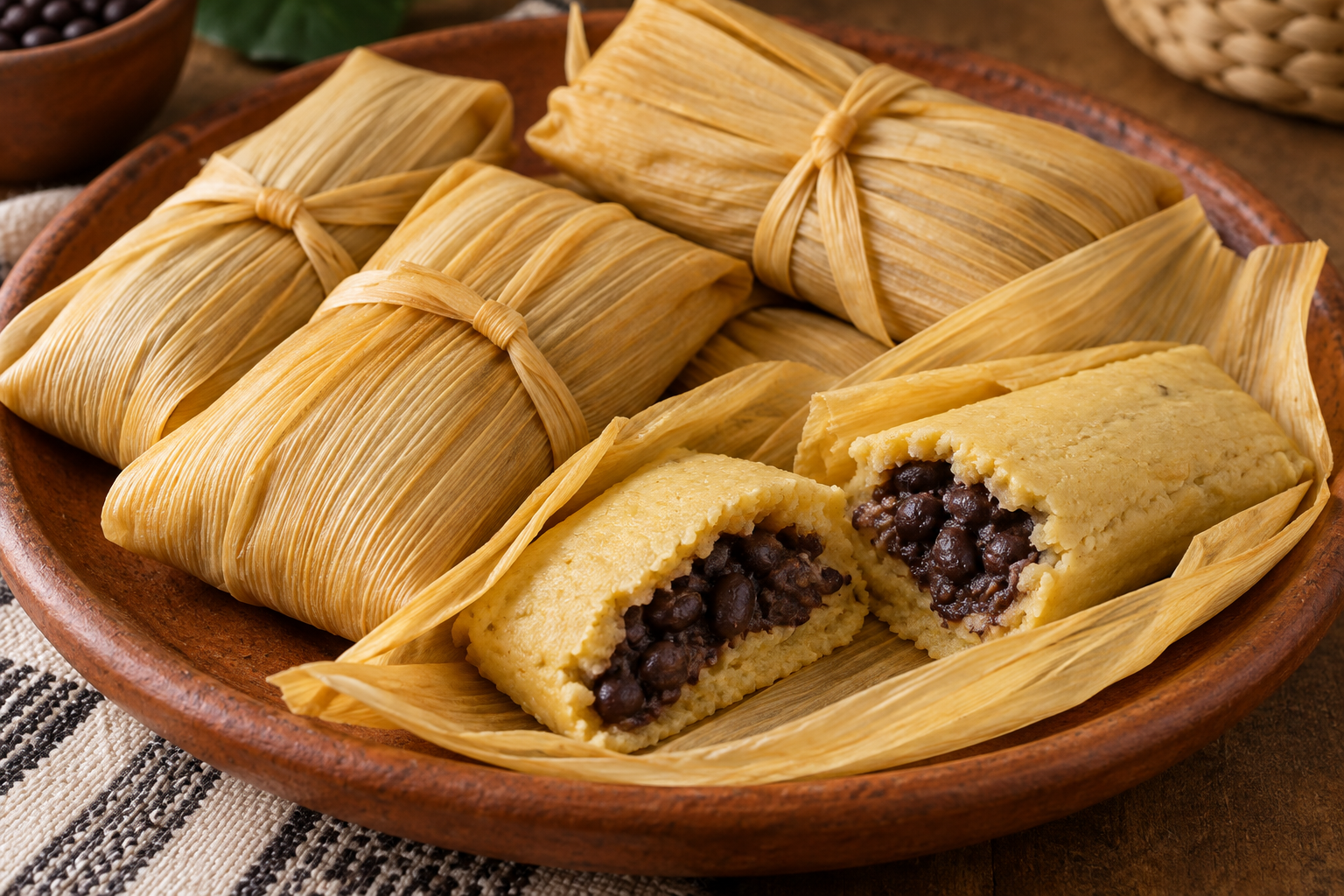
Our version uses commercially nixtamalized maize flour, water, a little oil, and cooked black beans in a corn-husk wrapper. The bean filling is a modern choice within a plausible Mesoamerican ingredient setting. Steaming produces a firm but tender dough without baking a crust. We avoid calling the exact formula an ancient surviving recipe.
The husk is structural: it keeps a soft dough portion together and makes a neat package. Soaking softens dry husks, while folding the narrow end prevents the dough from slipping out. Today's metal steamer and kitchen string replace uncertain ancient equipment. A modern oil helps the dough's texture; it is not presented as an attested ingredient of the depicted tribute.
The labor inside a parcel
Each tamal contains work before it contains filling. Maize needs preparation, grinding, hydration, portioning, wrapping, and heat. Commercial flour compresses that sequence into a bag, but it should not erase the skill that shaped ancient food production. Tribute food also implies people who supplied ingredients and cooked for occasions beyond their own household.
Serve the wrappers closed and invite diners to open them carefully. It is a practical interpretation of an attested maize-food format, with an explicitly chosen filling and modern quantities. A tamal is distinct from a thin griddle tortilla even when both begin with maize dough: thickness, enclosure, moisture, and heating method create a different meal. The vessel's food scene makes the social history visible; the recipe gives the cooking technique a present-day companion.
Corn-husk black-bean tamales
Serves 4 · Preparation 40 min · Cooking 50 min · 30 minutes husk soak; 10 minutes dough rest; 10 minutes cooked rest
A modern adaptation for home cooking. Times are approximate.
Ingredients
- 8 large food-grade dried corn husks, plus spare strips
- 250 g nixtamalized masa harina
- 330–380 ml warm water
- 30 ml neutral cooking oil
- 4 g salt, divided
- 240 g commercial cooked black beans, drained and lightly mashed
Method
- Soak corn husks in hot water 30 minutes, rinse and drain.
- Mix masa harina with 330 ml warm water, oil and 3 g salt; rest 10 minutes. Add water by spoonfuls for a soft spreadable dough.
- Season beans with remaining salt. Spread one-eighth dough in the center of each husk; add beans along the middle.
- Fold husk sides inward so dough encloses filling, fold narrow end upward, and tie lightly with a husk strip.
- Stand packets in a steamer, open end up. Steam over simmering water 45–50 minutes, replenishing hot water as needed, until dough is firm and pulls away from wrapper. Rest 10 minutes before opening.
Substitutions and adjustments
- Use food-grade banana leaves for a clearly labeled modern wrapper variation.
- Use commercial nixtamalized maize dough rather than plain cornmeal; adjust water accordingly.
Historical choices: Tamales are attested as a Classic Maya food category; bean filling, oil, corn-husk choice and measured steaming formula are adapted.
Kitchen note: Remove wrappers before eating and beware steam. Use fully cooked beans and refrigerate leftovers within 2 hours.
Sources and further reading
- British Museum, Maya: The Fenton Vase. Museum-authored food tribute interpretation; vessel broadly dated 600–800 CE, not securely entirely before 700.
- Metropolitan Museum, Maya ceramic contents. Museum discussion of inscriptions naming tamales; no precise recipe or filling.
- Carrasco Vargas et al., Daily life of the ancient Maya at Calakmul. Primary excavation and epigraphic study: Chiik Nahb murals dated approximately 620–700 CE include tamales and a maize-bread caption; no filling, wrapper material, or recipe proportions are established.


Comments
Post a Comment