Squash as a Bowl for Beans and Maize
ANCIENT MEALS · 087 / 100
Teotihuacan cultivated-food landscape · Basin of Mexico · c. 100–650 CE
Evidence: archaeological reconstruction. The historical evidence and modern cooking choices are distinguished below.
Three crops do not prove one recipe
Maize, beans, and squash are a familiar combination in accounts of Indigenous American agriculture. At Teotihuacan, the Plaza of the Columns archaeological project reports plant remains including those crops among a wider range of food resources. The evidence establishes ingredients in the city's food landscape; it does not certify a universal three-crop stew or the stuffed squash prepared below.
Research on carbonized food objects at the city shows why identifying a finished food differs from identifying a seed. A charred object can contain several components, and comparisons with modern experimental foods may help interpret it. Even such detailed analysis needs caution before a particular ancient recipe is named.
A vegetable becomes a container
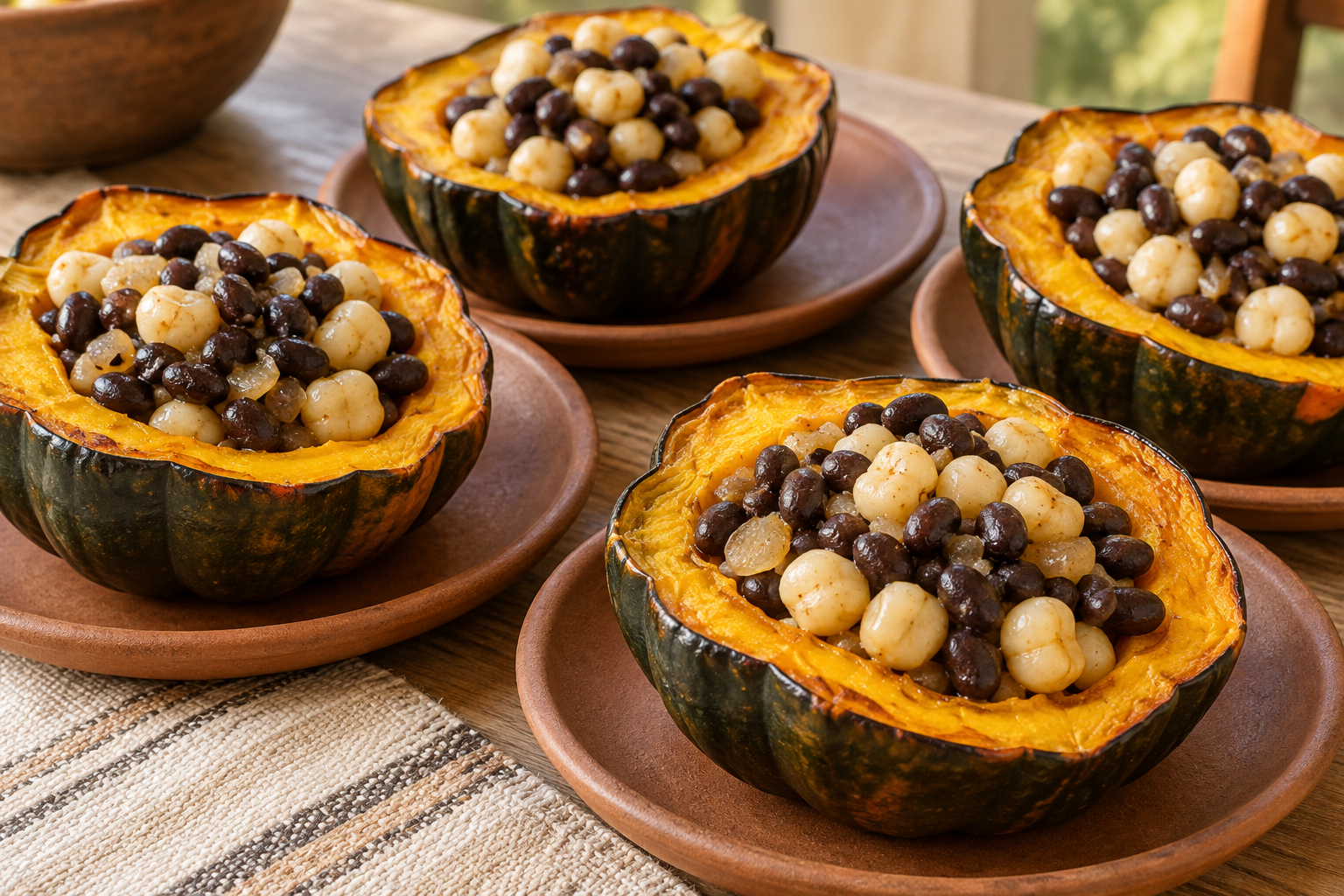
Our reconstruction bakes small winter-squash halves, then fills them with cooked black beans and commercial hominy. The hollow squash holds the mixture while its flesh remains part of the meal. This is a distinct format from maize dough or a bowl of thin soup: whole softened vegetable, separate grain and pulse, and a final shared heating stage.
The stuffed format, oven, and oil are present-day decisions. We do not claim that squash shells found archaeologically prove they were served this way. Modern acorn squash is a convenient cultivar, chosen for size and reliable edible flesh. Commercial cooked hominy retains larger maize kernels without requiring a home alkali process.
A household scale of interpretation
Feeding four people makes an archaeological ingredient list manageable. It also changes the question: we are choosing proportions for a contemporary meal, not measuring ancient calories or copying an urban ration. The beans are fully cooked before filling, and the squash is already tender before the mixture goes inside. Those checkpoints matter more for the modern cook than a romantic instruction to leave everything by a hearth.
Serve one filled half per person and encourage diners to scoop the flesh along with the filling. Maize, beans, and squash are supported by the cited finds; their assembled format, mild seasoning, quantities, and baking timetable are reconstruction. The article celebrates a versatile set of crops while avoiding the claim that all societies using them practiced the same gardening system or ate the same dish. Ancient ingredients can make a useful modern dinner without becoming an invented ancient formula.
Baked squash halves with black beans and hominy
Serves 4 · Preparation 20 min · Cooking 60 min · None
A modern adaptation for home cooking. Times are approximate.
Ingredients
- 2 small, about 1.5 kg total acorn or similar edible winter squash
- 400 g commercial cooked black beans, drained
- 350 g commercial cooked hominy, drained
- 20 ml neutral cooking oil
- 4 g salt
- 80 ml water
Method
- Heat oven to 200°C. Halve squash lengthwise and remove seeds. Brush cut surfaces with half the oil and half the salt.
- Bake cut side down on a lined tray for 35–45 minutes until flesh is tender.
- Warm beans and hominy in a saucepan with measured water, remaining oil and salt for 5 minutes.
- Turn squash halves upright, fill with bean mixture, and bake 10–15 minutes until filling is steaming hot. Serve one half per person.
Substitutions and adjustments
- Use small edible pumpkin halves or large thick pumpkin wedges with filling served beside them.
- Use cooked pinto beans instead of black beans as a modern cultivar choice.
Historical choices: The three crops are attested at Teotihuacan; using squash as a baked serving container is an explicit reconstruction.
Kitchen note: Use fully cooked beans and commercial hominy. Discard spoiled squash and refrigerate leftovers within 2 hours.
Sources and further reading
- Plaza of the Columns, Plant-based Diet and Plants. Specific archaeobotanical project lists maize, beans and squash among recovered resources; no stuffed dish.
- Amorphous carbonized food objects from Teotihuacan. Peer-reviewed research on interpreting multi-component foods and limits of identifying precise recipes.


Comments
Post a Comment