The Pot Remembers: Barley, Peas and Milk at Çatalhöyük
ANCIENT MEALS · 025 / 100
Late Neolithic to early Chalcolithic farming community · Çatalhöyük West Mound, central Anatolia, modern Turkey · Approximately 5900–5800 BCE
Evidence: archaeological reconstruction. The historical evidence and modern cooking choices are distinguished below.
An ingredient list inside a pot
A bowl can keep a memory even when no recipe was written down. At Çatalhöyük West, in central Anatolia, researchers studied proteins preserved in deposits on pottery dating approximately 5900–5800 BCE. The published research by Jessica Hendy and colleagues identifies cereals, pulses and dairy among the foods represented. This offers a much more specific starting point than simply gathering ingredients known somewhere in the ancient world.
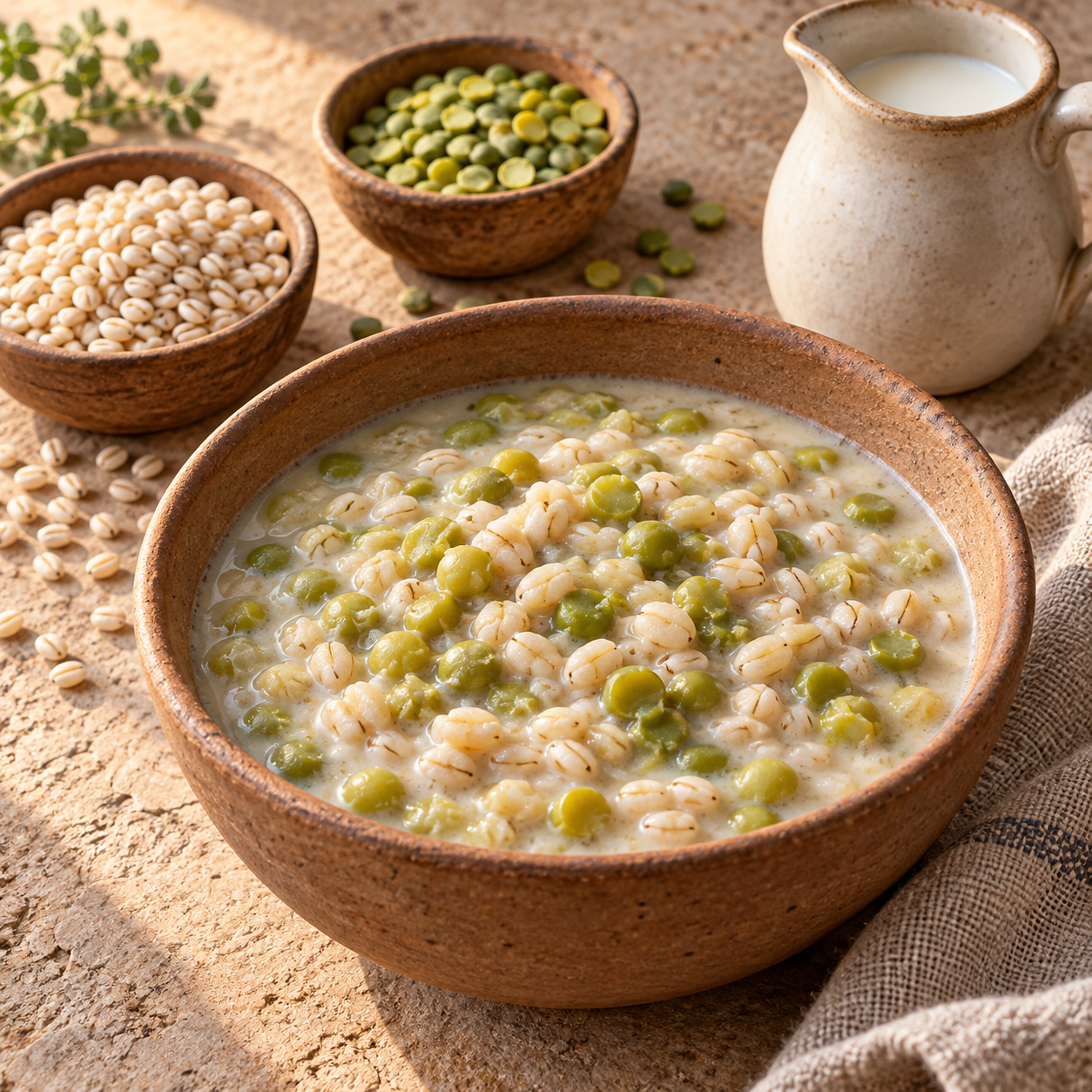
The research team’s explanation names barley and wheat, peas and vetches, and milk from sheep, goats and cattle. It also gives the essential caution: finding several food groups in a vessel might reflect a combined meal, repeated uses of the same pot, or both. Our barley, pea and milk pot explores the mixed-meal interpretation. The archaeological analysis cannot establish this recipe’s proportions or prove that its ingredients were cooked simultaneously.
A creamy meal with a grain texture
We use commercially prepared pearl barley and dried split peas. These are modern market forms, selected because they can become tender on a manageable schedule. No wild vetch is required. Water does most of the cooking; pasteurized milk enters near the end, reducing the need to stir dairy throughout a long simmer. The result is intended to be a spoonable meal with recognisable grain, rather than a drink or a smooth pulse puree.
Barley and peas do not always soften at precisely the same rate. Inspect both before adding milk, and add hot water when the pot threatens to catch. A heavy saucepan and gentle bubbling make that judgement easier. The ancient residue does not preserve a stove setting, and the instruction to check tenderness is part of our modern cooking method.
Why the missing details matter
The vessel is the centre of the story. Its deposits connect food with a particular site and interval of time, yet do not let us name the diner or identify a daily household menu. Nor should evidence for milk automatically be turned into evidence for the exact fresh dairy product pictured here. We have chosen milk because it is straightforward to buy pasteurized and because it makes the ingredient relationship easy to understand.
Serve the meal warm in small bowls, adding only a little salt if needed. Its final thickness depends on the grain and pulse brands. A successful modern dinner would demonstrate one possible interaction of the evidenced ingredients. It would not settle whether an ancient pot once held soup, porridge, a sequence of different foods, or another preparation entirely.
Barley, split pea and milk pot
Serves 4 · Preparation 10 min · Cooking 65 min · None
A modern adaptation for home cooking. Times are approximate.
Ingredients
- 140 g pearl barley, rinsed
- 150 g dried green split peas, rinsed
- 1 litre water, plus extra as needed
- 400 ml pasteurized whole milk
- ½ tsp salt, or to taste
Method
- Put barley, split peas and water in a heavy saucepan. Bring to a full boil, then reduce to a gentle simmer.
- Cook partly covered for 45–55 minutes, stirring frequently after the first 20 minutes. Add hot water as needed to prevent sticking.
- When both peas and barley are soft, add milk gradually. Simmer gently for 10 minutes, stirring; keep below a vigorous boil.
- Season with salt and serve warm. For a thinner meal, stir in a little additional hot milk or water.
Substitutions and adjustments
- Pasteurized goat milk is an alternative dairy choice consistent with the identified animal groups.
- Use pasteurized lactose-free cow milk as a modern dietary adaptation.
Historical choices: Inspired by proteins in vessels from a defined Çatalhöyük West assemblage. A combined cereal–pulse–dairy meal is one interpretation; sequential vessel use remains possible.
Kitchen note: Use commercially sold pulses and pasteurized milk. Cool in shallow containers and refrigerate within 2 hours.
Sources and further reading
- Hendy et al.: Ancient proteins from ceramic vessels at Çatalhöyük West. Primary protein study; cannot by itself distinguish all mixed meals from successive uses.
- Max Planck research-team explanation. Specific identified crops and dairy groups, vessel dates, and explicit caveat about mixing.


Comments
Post a Comment