Pālūda: Apple Juice, Quince and an Uncertain Set
ANCIENT MEALS · 030 / 100
Middle Persian court literature · Sasanian Iran, literary court setting · Sasanian court tradition, approximately 531–628 CE; preserved in later manuscripts
Evidence: historically informed adaptation. The historical evidence and modern cooking choices are distinguished below.
A fruit sweet with missing instructions
The intriguing detail is juice rather than whole fruit. A sweet called pālūda appears in Husraw and the Page; Encyclopaedia Iranica’s discussion associates it with apple and silver-quince juices. Raham Asha’s edition, section 41, foregrounds apple juice in its reading. That difference is a reason to identify the sources, not to hide them behind a confident claim about the original fruit mixture.
Our recipe chooses apple and quince following the broader scholarly interpretation, but does not identify a modern quince cultivar with the historical descriptive term. It also supplies a wheat-starch thickener. The surviving passage does not specify that ingredient or explain how the sweet set. This is therefore a historically informed adaptation of a named juice-based sweet, rather than an exact surviving jelly recipe.
Extract first, thicken later
Cooking sliced fruit in water makes an accessible juice base without a mechanical juicer. We strain it gently instead of pressing every last particle through the cloth. That keeps the final texture distinct from stewed fruit or a puree. A cloudy liquid is perfectly acceptable; a mass of pulp is a different preparation.
Commercial food-grade wheat starch supplies a modern thickening method; the finished set will vary with ingredients. Mixing it into cold liquid before adding it to the hot juice reduces clumping. The final simmer cooks the starch completely, after which the mixture can cool into a soft spoonable sweet. It is intended to settle in small bowls, not to stand as a sharply cut confection or imitate a later named dessert.
Keeping a textual gap open
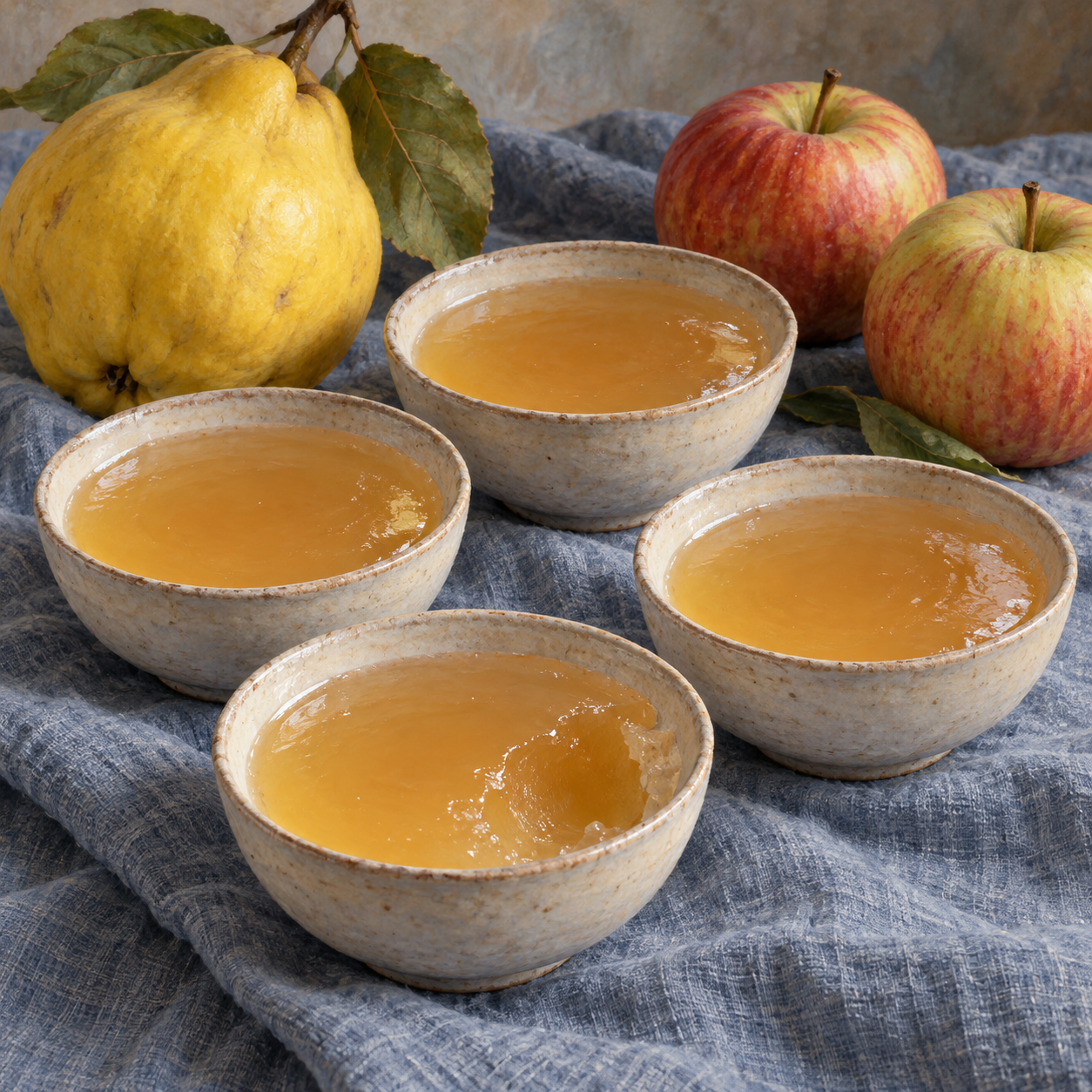
The scholarly account of the work situates its tastes in a Sasanian court tradition preserved by later witnesses. It is not a laboratory report identifying a thickener. Likewise, the appealing image of a translucent bowl cannot recover a lost instruction. Its role is to show our chosen result while leaving the historical gap visible.
Serve a modest bowl cold, with the original fruits nearby if you want to make the extraction step understandable. Sweetness and acidity vary, so adjust sugar in the juice before adding starch. Its appeal lies in focusing on a juice-based ancient food description and asking what a modern cook must supply to turn it into a measured modern format. The fruit choice has a scholarly basis; the extraction ratio, starch amount, saucepan technique and refrigerator setting belong to this recipe.
A spoonable sweet, with a measured base
The useful measurement is the strained liquid, not the starting weight of fruit: this version thickens 650 ml. Keep 100 ml of that liquid cool for the starch slurry and heat the remaining 550 ml with the sugar. Stir the slurry again immediately before adding it, because the starch settles while it stands. The hot mixture should coat a spoon and leave a brief trail when stirred; the intended cold result is a soft bowl dessert, not a firm jelly to unmould.
Apple and quince vary, so use the stated texture cues to judge the finished set. The Incoprea cooking page brings this historical series together with the other recipe collections. You can also follow the Ancient Meals book in preparation in the cookbook section.
Soft apple and quince juice jelly
Serves 4 · Preparation 25 min · Cooking 50 min · 15 minutes draining and at least 2 hours chilling
A modern adaptation for home cooking. Times are approximate.
Ingredients
- 400 g apples, washed, cored and thinly sliced
- 300 g quince, washed, cored and thinly sliced
- 850 ml water
- 40–60 g sugar, to taste
- 35 g commercial food-grade wheat starch
Method
- Put the prepared apple and quince slices and 850 ml water in a saucepan. Bring to a boil, cover and simmer gently for about 35–40 minutes, until both fruits can be broken apart easily with a spoon. Keep enough liquid in the pan to prevent scorching.
- Set a fine sieve lined with clean food-safe cloth over a heatproof bowl. Pour in the cooked fruit and liquid carefully. Let drain for 15 minutes without vigorous pressing; the aim is strained liquid, which may be cloudy, rather than a thick fruit purée. Refrigerate the solids promptly for a separate use or discard them.
- Measure exactly 650 ml strained liquid. Add water if the yield is short, or reserve any surplus separately. Pour 100 ml into a small bowl and let it cool; return the remaining 550 ml to the saucepan.
- Add 40 g sugar to the saucepan, warm until dissolved, and taste a little cooled liquid. Add up to the remaining 20 g sugar if desired. Adjust sweetness now, before the starch thickens the mixture.
- Whisk 35 g wheat starch into the cool 100 ml liquid until no dry lumps remain. Bring the sweetened liquid to a gentle simmer. Re-stir the slurry immediately before pouring it in as a thin stream, whisking the saucepan continuously.
- Cook gently for about 5 minutes, stirring across the base and into the corners of the pan so the mixture does not catch. It should thicken enough to coat a spoon and briefly show the path of a stirring spoon. This is intended as a soft spoon dessert; the formula is not intended to set as a sliceable block.
- Divide among four small heatproof bowls. Cool promptly, refrigerate within 2 hours, and chill at least 2 hours before serving cold. Use within 3 days.
Substitutions and adjustments
- For the stated method, use commercial food-grade wheat starch, not wheat flour; the two are not interchangeable here. Wheat starch may contain gluten.
- Rice starch is a possible modern variation, but its setting behaviour differs; it is not a direct measured substitute.
- Use all apples if quince is unavailable; this also reflects the apple-focused reading in the cited edition.
Historical choices: Ancient text names a fruit-juice sweet; scholarly readings differ on quince. The wheat-starch set and measured method are modern and are not claimed as ancient.
Kitchen note: Use commercial food-grade starch and cook it fully. Wheat starch may contain gluten. Refrigerate promptly and use within 3 days.
Sources and further reading
- Encyclopaedia Iranica: Cooking in Pahlavi Literature. Apple and silver-quince interpretation of the named jelly.
- Raham Asha: Husraw and the Page, section 41. Apple-focused reading; neither source supplies this starch method.
- Encyclopaedia Iranica: Husraw and the Page. Textual transmission and court-literature context.


Comments
Post a Comment