Lotus Rhizomes and Fish Beside a Han Tomb
ANCIENT MEALS · 073 / 100
Western Han elite food landscape at Mawangdui · Changsha, Hunan, China · c. 168 BCE
Evidence: archaeological reconstruction. The historical evidence and modern cooking choices are distinguished below.
Food names with an afterlife
A tomb can preserve a surprisingly lively vocabulary of eating. Wooden food labels from Mawangdui include soup, carp, roasted chicken, lamb stew, and other dishes. The Hong Kong Antiquities and Monuments Office's exhibition entry identifies a set excavated from Tomb 1 in Changsha in 1972, now in Hunan Museum. A label is a trace of naming and provisioning, not a written cooking method.
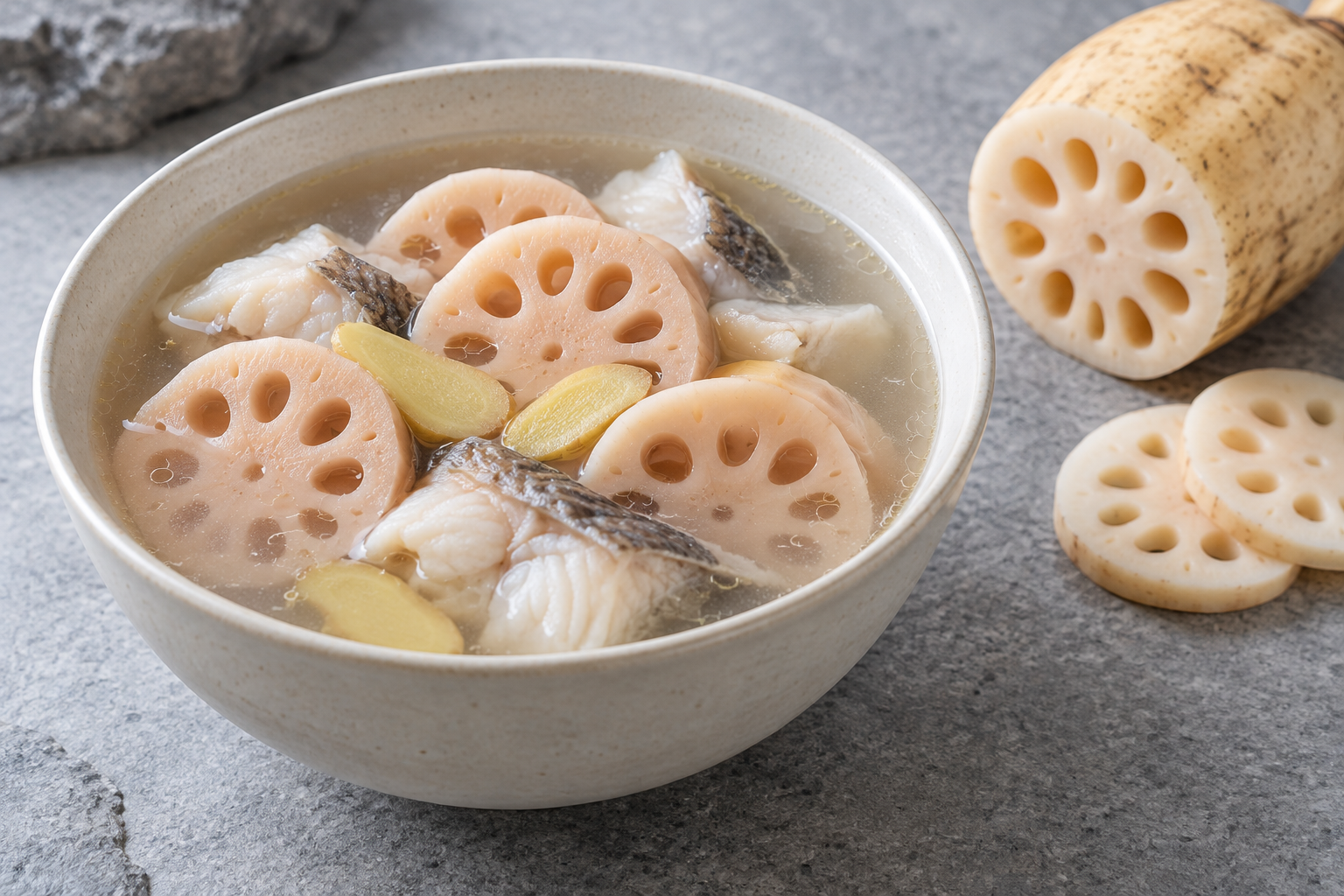
The museum evidence also places lotus rhizome within a broader Han ingredient landscape. The International Council of Museums regional heritage volume includes Hunan museum discussion of the actual food, inventories, and texts from Mawangdui, and lists lotus root among the plant foods. Our soup combines that rhizome with fish, but it is not claimed as an exact dish recovered intact from a tomb vessel.
A wetland food has a texture
Lotus grows in water and stores resources in its underground stems. The sliced rhizome's repeated holes make a memorable cross-section. Modern fresh lotus root can remain crisp after a brief cooking or grow softer with a longer simmer. Here we give it a head start before adding fish, so both ingredients finish in a useful state.
Boneless carp would keep the strongest link to the named fish, but a home cook may find another mild freshwater fish more readily. We explicitly allow that substitution. Ginger is used sparingly as an aromatic choice within the wider Han food setting; its quantity and position in this soup are ours. Clear water rather than a heavily seasoned modern stock lets the rhizome and fish define the bowl.
Whose table does a tomb describe?
Elite burial provisioning is selective evidence. It can tell us what was considered appropriate for a particular deceased person and household without becoming a menu for every farmer or craft worker in Han China. Abundance, ritual, and status help shape what entered the grave. Our four-serving saucepan is a modern scale of use.
Serve the fish in large flakes with the perforated lotus slices clearly visible. This reconstruction turns a documented ingredient landscape into one plausible cooking arrangement. The dates and place anchor its historical story; the combination, measurements, and boneless preparation remain declared choices. A bowl can open conversation about wetlands, social rank, and preservation without pretending that archaeology supplied a complete recipe.
Lotus-root and freshwater-fish soup
Serves 4 · Preparation 20 min · Cooking 35 min · None
A modern adaptation for home cooking. Times are approximate.
Ingredients
- 400 g fresh lotus root, peeled and sliced 5 mm thick
- 450 g boneless carp or mild freshwater fish fillet, cut into large pieces
- 15 g fresh ginger, sliced
- 1.2 litres water
- 4 g salt
Method
- Inspect and rinse peeled lotus root, including the holes; discard any spoiled sections. Slice.
- Bring water, lotus root and ginger to a boil; reduce heat and simmer covered for 25 minutes until lotus is tender to your liking.
- Add fish and salt. Simmer gently 6–10 minutes, depending on thickness, until fish reaches 63°C and flakes easily.
- Check carefully for bones before serving. Divide fish and lotus among four bowls and add broth.
Substitutions and adjustments
- Use boneless trout or another mild fish when carp is unavailable; the named species changes.
- Frozen plain lotus slices can replace fresh; follow package cooking advice.
Historical choices: Lotus rhizome and fish belong to the Mawangdui food evidence; their combination and all recipe details are a plausible reconstruction.
Kitchen note: Use fresh food-grade lotus and boneless commercially sold fish. Cook fish to 63°C and check for bones.
Sources and further reading
- Antiquities and Monuments Office: Mawangdui food slips. Museum labels including soup and carp; does not supply this recipe.
- ICOM: Regional Museums and Local Gastronomic Heritage. Hunan Museum discussion identifies lotus root and other ingredients at Mawangdui; PDF source.


Comments
Post a Comment