Roman Eggs with a Honey-Vinegar Pine-Nut Sauce
ANCIENT MEALS · 049 / 100
Late Roman cookbook tradition · Roman Mediterranean · Approximately 390–450 CE compilation, with earlier material
Evidence: adapted surviving recipe. The historical evidence and modern cooking choices are distinguished below.
The sauce makes the dish
At the end of Apicius, Book VII, an instruction for eggs gives a short sauce list: pepper, lovage, soaked nuts, honey, vinegar, and a salty liquid. The Latin heading refers to soft eggs, while the older English version renders the preparation as poached eggs. That difference illustrates why translating an ancient heading is not the same as recovering a complete kitchen procedure.
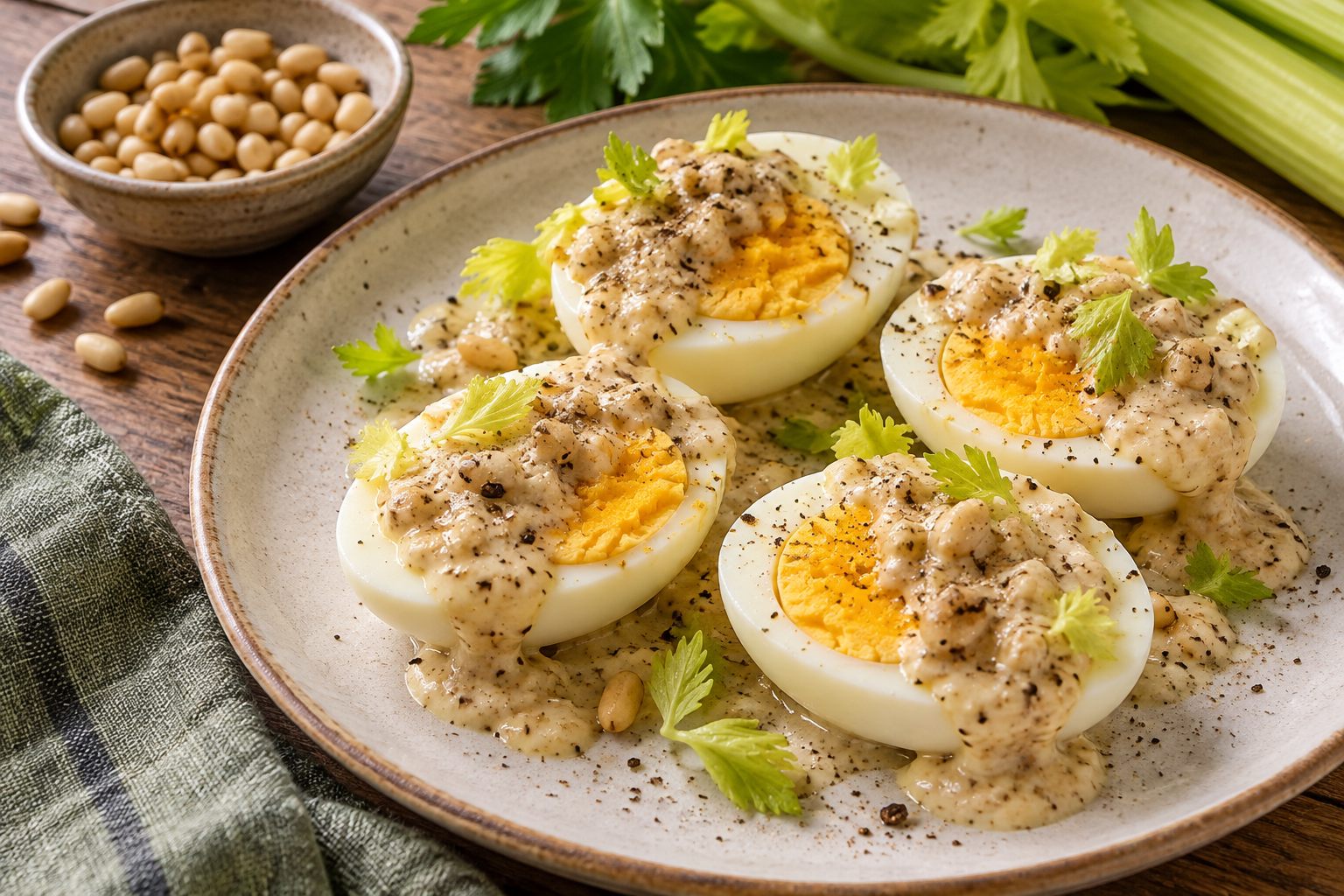
The Latin text's in ovis hapalis records the sauce framework but supplies no measured recipe or detailed nut preparation. Our version uses commercially shelled pine nuts, briefly softened in hot water and crushed, then served over fully cooked boiled eggs. Cooking the eggs until both whites and yolks are firm is a declared modern safety adaptation. It changes the original softness while preserving eggs as the main food and the sauce as its defining companion.
Building texture from soaked nuts
Soaking and crushing make the nuts into a coarse, spoonable dressing. Honey rounds the vinegar's edge, pepper adds warmth, and the salty element prevents the sauce from becoming merely sweet. Commercial fish sauce gives an accessible analogue for liquamen; it is not an exact duplicate of ancient Roman fish sauces. A fish-free replacement with salt and water is offered openly. Celery leaf substitutes for lovage if that herb is unavailable.
No raw egg is beaten into the dressing. It thickens through crushed nuts, which makes this dish distinct from an egg-bound patina. It also differs from the cooled pea purée in this collection, where chopped eggs accompany a legume base. Here the egg halves occupy the centre of the plate and receive a separate nut sauce. These differences involve the food's structure and preparation, not just swapping one garnish.
A small dish without an invented occasion
The cookbook tradition belongs to the late Roman period, approximately fourth to fifth century CE, though its component recipes can be older. This short passage does not identify a festival or an emperor who ate it. Presenting it as a documented sauce for eggs is already an engaging story: a familiar food receives a combination that unsettles modern expectations about sweet and savoury flavours.
Prepare the sauce while the eggs cook and peel them after cooling briefly. Serve warm or at room temperature soon after assembly. Pine nuts differ in size and moisture, so add water a teaspoon at a time to reach a spoonable texture rather than assuming a fixed ancient thickness.
Cooked eggs with pine-nut honey-vinegar sauce
Serves 4 starter portions · Preparation 15 min · Cooking 10 min · Soak pine nuts 15 minutes.
A modern adaptation for home cooking. Times are approximate.
Ingredients
- 4 large eggs
- 40 g commercial shelled pine nuts
- 50 ml hot drinking water, plus up to 2 tbsp for sauce
- 2 tsp honey
- 2 tsp wine vinegar
- 1 tsp commercial fish sauce
- 1 tsp chopped lovage or celery leaves
- ¼ tsp black pepper
Method
- Cover pine nuts with 50 ml hot water and let soften for 15 minutes; drain.
- Cover eggs with cold water, bring to a boil, and simmer gently for 10 minutes until whites and yolks are firm. Cool briefly, peel, and halve.
- Crush pine nuts with pepper and leaves in a mortar. Work in honey, vinegar, and fish sauce.
- Add water by teaspoons until the sauce is spoonable but still textured.
- Arrange two egg halves per portion and spoon sauce over them.
Substitutions and adjustments
- Celery leaf can replace lovage; this changes the aroma.
- For a fish-free sauce, use 1 tbsp water and a small pinch of salt instead of fish sauce.
Historical choices: Apicius VII attests the nut-honey-vinegar sauce for soft eggs. Fully cooked boiled eggs are a safety adaptation; quantities and nut texture are interpretive.
Kitchen note: Cook eggs until both whites and yolks are firm, or use an appropriate pasteurized product if adapting softness. Refrigerate promptly; nuts are an allergen.
Sources and further reading
- Apicius, Book 7: English translation. Public-domain Vehling translation; editorial additions are distinguished from the ancient instruction.
- Bibliotheca Augustana: Apicius, Latin Book 7. University-hosted primary Latin text for the recorded ingredient and method framework.


Comments
Post a Comment