Citron in Syrup: A Preserve Named at the Sasanian Court
ANCIENT MEALS · 028 / 100
Middle Persian court literature · Sasanian Iran, literary court setting · Sasanian court tradition, approximately 531–628 CE; preserved in later manuscripts
Evidence: historically informed adaptation. The historical evidence and modern cooking choices are distinguished below.
A preserve in a conversation
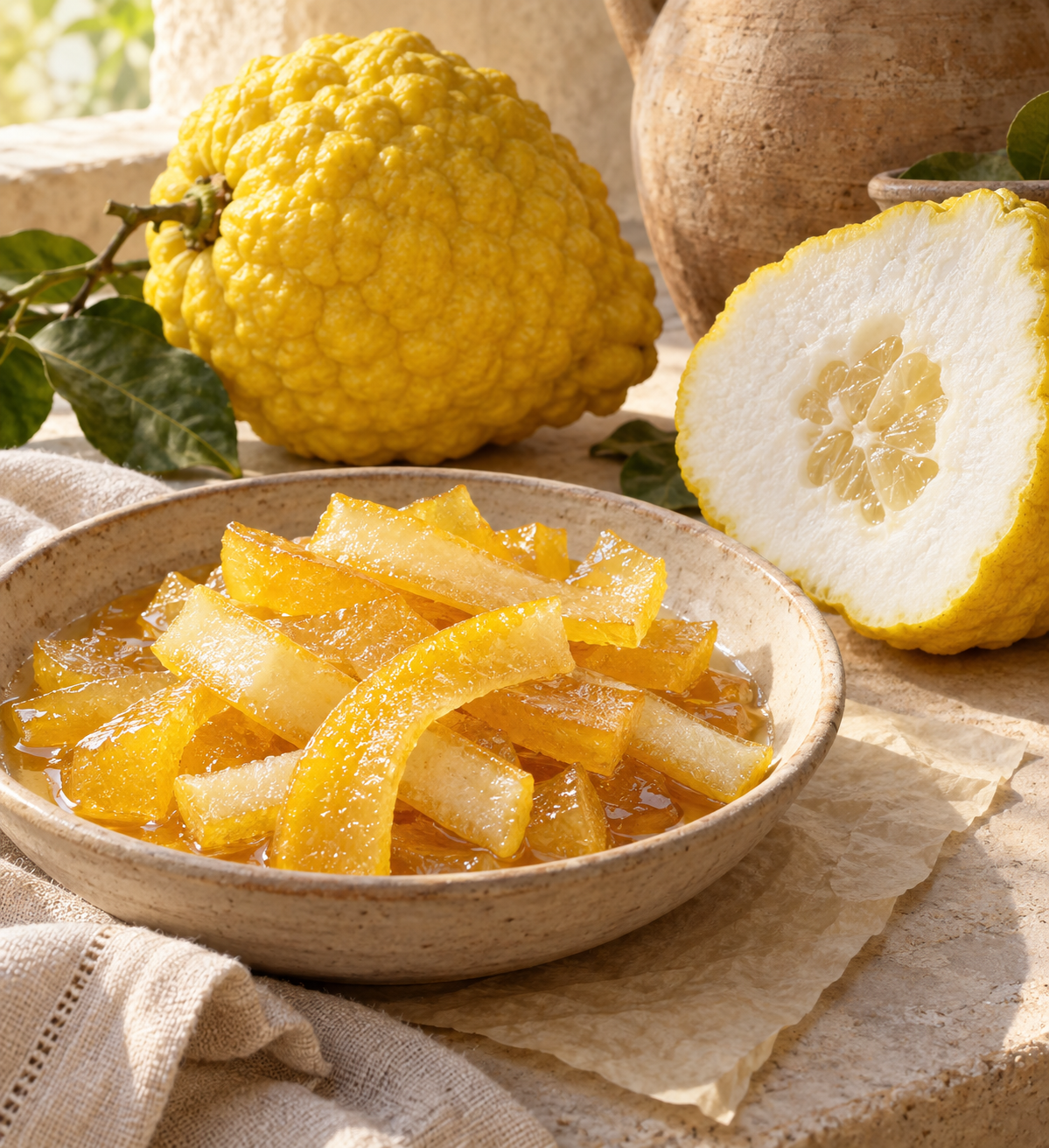
The citron looks rather different when cut open: thick white pith surrounds a comparatively small centre of flesh. That structure makes the peel the focus of this recipe. Citron appears among preserves discussed in the Middle Persian text usually called Husraw and the Page. Raham Asha’s edition, sections 43–46, preserves the relevant food list; Jaleh Amuzgar’s culinary discussion identifies the citron term. Neither gives our measured peel-only method.
The text presents cultivated judgement at a royal court. Its ancient connection is to the Sasanian world, broadly the sixth and early seventh centuries CE, but the surviving textual witnesses are later. The scholarly account of the work discusses both its court setting and manuscript transmission. A literary conversation cannot be treated as a contemporary household cookbook, and the name of a preserve does not recover its sugar concentration or storage life.
Working with a thick peel
Our modern adaptation blanches strips of citron peel before simmering them with sugar. The preliminary water changes reduce some bitterness and soften the pith. They are practical decisions for the fruit you buy, rather than instructions copied from the ancient passage. Keep a little pith attached: removing all of it changes both the size and texture of the finished pieces.
The simmering stage aims for tender, translucent strips in a small amount of syrup. It does not aim for dry crystallised candy or a spreadable jam. Those are different food forms, even if a loose translation calls all of them preserves. Check tenderness with a clean fork, and add water if the pan becomes dry before the peel softens.
A name without a complete process
Citron gives this plate a direct connection with the named ancient food. If citron is unavailable, the recipe supplies a lemon-peel alternative, but it is clearly a modern substitution and needs a shorter preliminary cook. Neither option establishes continuity with a later regional sweet simply because the citrus aroma seems familiar.
Serve a few strips with a little syrup in a small dish. It is intentionally a fresh refrigerated preparation, to be used within a few days, rather than a method for preserving food at room temperature. The historical evidence supports the named fruit-preserve category. The peel selection, water changes, sugar ratio and short storage period belong to this adaptation, allowing an interesting ancient reference to become a usable and carefully bounded kitchen exercise.
Three checks before serving
Judge the peel and syrup separately. The strips should bend rather than snap after blanching, then become tender enough for a fork to pass through the white pith during the syrup simmer. Thick-pithed fruit may need longer than the suggested time. If the liquid reduces before that happens, add a tablespoon of water and continue gently; a sticky pan is a sign to add water, not proof that the peel is ready.
This is a small refrigerated dessert, with syrup left for spooning over the strips. It is not a tested preserve for a pantry shelf. For more fruit and grain ideas, explore Cooking at Incoprea; the cookbook section tracks the Ancient Meals book while it is in preparation.
Tender citron peel in syrup
Serves 8 · Preparation 25 min · Cooking 70 min · Cooling and at least 1 hour chilling
A modern adaptation for home cooking. Times are approximate.
Ingredients
- 250 g washed fresh food-grade citron peel, with some white pith, cut in 1 cm strips
- 200 g sugar
- 300 ml water for syrup, plus fresh water for blanching
Method
- Choose a small saucepan that holds the strips without packing them tightly. Keep the yellow outer peel and some white pith; trim away any remaining flesh and very uneven thick lumps. The listed 250 g is the weight of prepared peel, cut into strips about 1 cm wide.
- Cover the peel generously with fresh water. Bring to a boil, then simmer 10 minutes. Drain carefully and repeat twice with fresh water, giving three 10-minute blanchings. The strips should be flexible; very thick pith may need a little longer in plain water.
- Put the drained peel, 200 g sugar and 300 ml water in a clean saucepan. Warm gently, stirring the liquid until the sugar dissolves, then bring to a gentle simmer. Keep the strips largely submerged, turning them occasionally with a spoon.
- Simmer uncovered for about 30–40 minutes. Check the thickest strip with a fork: it should pierce the pith easily, and the peel should look more translucent. If the syrup thickens before the peel is tender, add water a tablespoon at a time and continue; do not let the pan cook dry.
- Leave some syrup around the tender strips rather than boiling to a dry candy coating. Transfer to a shallow clean container and cool promptly. Refrigerate within 2 hours, then chill at least 1 hour before serving. Use within 3 days.
- Spoon a few cold strips and a little syrup into each small dish. This is a fresh refrigerated preparation; do not seal it for room-temperature storage.
Substitutions and adjustments
- Use 200 g food-grade lemon peel with some pith if citron is unavailable. Blanch twice rather than three times and check tenderness frequently. This changes the ancient named fruit.
- Reserve citron flesh for a separate use; the peel-only choice is modern.
- Peel thickness and bitterness vary by fruit. Use tenderness as the endpoint; the stated blanching and simmering times are starting points, not guarantees.
Historical choices: Citron preserves are named in Husraw and the Page. This peel-only blanching and syrup method is a modern adaptation, not a recovered ancient formula.
Kitchen note: Use food-grade fruit suitable for eating the peel. This is not a tested canning recipe; refrigerate promptly and use within 3 days.
Sources and further reading
- Raham Asha: Husraw and the Page, sections 43–46. Primary-text edition includes the named preserve category; no measured peel recipe.
- Encyclopaedia Iranica: Cooking in Pahlavi Literature. Scholarly identification of citron among preserves.
- Encyclopaedia Iranica: Husraw and the Page. Court setting and later textual transmission.


Comments
Post a Comment