Fish Broth with Barley: A Greek Papyrus Pot
ANCIENT MEALS · 012 / 100
Greek-language culinary papyrus · Greek-speaking eastern Mediterranean; papyrus provenance unknown · Approximately 200–500 CE; catalog dates vary between fragments
Evidence: adapted surviving recipe. The historical evidence and modern cooking choices are distinguished below.
A title and a pot of clues
A fragmentary fish-broth instruction brings grain into the same pot as herbs and liquid. In Friedrich Bilabel’s 1920 edition of the Heidelberg culinary papyrus, the translated passage includes groats, coriander, onion, dill, wine and water, with a sharp finishing addition. Broken words and uncertain readings remain visible in the edition. That is valuable information, not clutter to erase when writing a modern recipe.
The official Heidelberg catalogue dates the relevant cookbook fragments broadly within the third to fifth centuries CE and records unknown provenance. We therefore place this dish in the Greek-speaking eastern Mediterranean world without inventing an exact city of origin. Its text has travelled into a modern archive more clearly than its original cooking location can be reconstructed.
Building an accessible broth
Our version uses pearl barley, a convenient modern groat, and adds boneless white fish near the end. The fragment’s broth terminology does not securely specify our fish species or cut. Choosing chunks of tilapia, cod or hake is a practical adaptation that turns the preparation into a complete meal and makes safe cooking straightforward.
Cook the barley before introducing the fish. A grain that needs a long simmer and a fillet that needs only a few minutes should not be forced into the same timetable. Leek and onion soften into the broth, while dill stays brighter when added late. The wine quantity and the final vinegar are measured here to give a mild, adjustable acidity rather than an overpowering sour taste.
The ending is a technique
A late splash of vinegar changes the broth after its ingredients have cooked. Taste first, add a little, then taste again. The exercise makes the role of a finishing instruction visible: the cook is adjusting a meal, not just following a list from beginning to end. We omit an uncertain juice term rather than assigning it a confident modern equivalent.
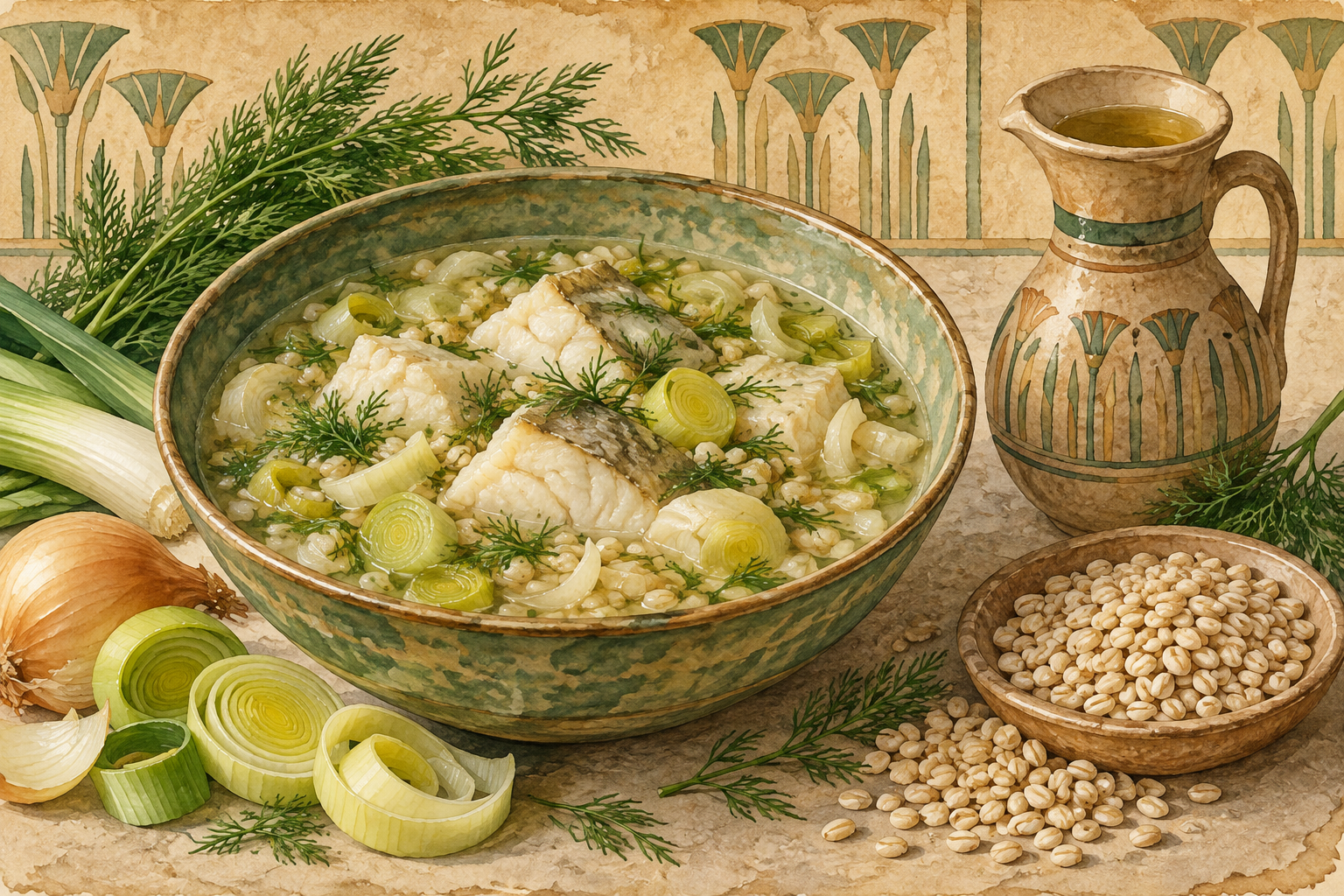
Barley absorption and fish thickness vary, so add water to maintain a broth and check the fish itself for doneness. Serve in shallow bowls where the grain, herbs and fish remain visible. The generated illustration is a depiction of this modern adaptation. It cannot establish how an ancient bowl looked, but it can help the reader understand the sequence we have chosen from a damaged, yet remarkably useful, cooking text.
Fish and barley broth with dill and vinegar
Serves 4 · Preparation 15 min · Cooking 50 min · None
A modern adaptation for home cooking. Times are approximate.
Ingredients
- 120 g pearl barley
- 600 g boneless white-fish fillets, in large chunks
- 150 g leek, well washed and sliced
- 1 onion, chopped
- 1.2 litres water or commercial fish stock
- 150 ml commercial white wine or water
- 1 tsp coriander seeds, crushed
- 15 g fresh dill, chopped
- ½ tsp anise seed, crushed
- 1 tbsp olive oil
- 1–2 tsp wine vinegar
- ½ tsp salt, or to taste
Method
- Cook onion and leek in oil for 5 minutes. Add barley, water or stock, wine, coriander and anise.
- Bring to a boil, then simmer 30–40 minutes until barley is tender. Add water if needed to keep it brothy.
- Add fish and simmer gently 6–10 minutes, until it reaches 63°C/145°F and flakes easily.
- Stir in dill and 1 tsp vinegar. Taste, add more vinegar if desired, season and serve.
Substitutions and adjustments
- Tilapia, hake or cod are practical modern fish choices.
- Water replaces wine; vegetable stock changes the historical flavour basis.
Historical choices: Adapted from a fragmentary fish-broth passage. Pearl barley and fish chunks are modern specifications; uncertain juice is omitted.
Kitchen note: Cook fish to 63°C/145°F; check for bones and refrigerate leftovers promptly.
Sources and further reading
- Bilabel: Opsartytika und Verwandtes. Public-domain scholarly edition and German translation, fish broth section; uncertain readings shown.
- Heidelberg: G 1701 catalogue. Confirms cookbook fragments but records unknown provenance.


Comments
Post a Comment