Mersu: A Royal Delivery Notice Becomes a Date Sweet
ANCIENT MEALS · 005 / 100
Old Babylonian Mari · Mari on the Euphrates, modern Syria · Approximately 1775–1761 BCE
Evidence: archaeological reconstruction. The historical evidence and modern cooking choices are distinguished below.
The shopping list survives
Sometimes the archive gives us dinner indirectly. A delivery record from Mari links dates and pistachios with making mersu for a royal meal. The Biblical Archaeology Society’s discussion explains how that administrative notice, rather than a complete cooking instruction, informs modern reconstructions. Its setting is the reign of Zimri-Lim in the eighteenth century BCE, on the Euphrates in what is now Syria.
A quantity received by a palace is not a household recipe. It does not tell us whether the dates were boiled, whether flour entered another version, how large each portion was or what shape the finished food took. Modern enthusiasm sometimes turns this fragment into a confident claim about an exact ancient energy ball. The distinction matters: the pairing is evidenced, while the little rounds pictured here are our own practical format.
A confection with visible choices
The modern Harvard Museum of the Ancient Near East reception menu, developed with food scholar Nawal Nasrallah, also presented mersu as a date confection. That provides a useful example of scholarly public interpretation, not proof that every ancient version had the same texture. In our recipe, soft dates supply sweetness and structure; pistachios supply a contrasting crunch. A small amount of butter helps the mixture come together.
We heat the date paste briefly with water before shaping it. This softens dry fruit and makes the method workable without asking a cook to grind everything by hand. The result is dense rather than fluffy, and intentionally contains no raw flour. If the paste is too sticky, let it cool longer before making the rounds. If it is too dry, add water by the teaspoon instead of pouring in enough to turn it into a sauce.
The pleasures and limits of an archive
Arrange the sweets beside a few dates and pistachios so the ingredient relationship stays visible. A simple bite can open a discussion of how food history is recovered: not only through cookbooks, but through accounts recording deliveries and labour. The person compiling the record did not need to explain the kitchen’s method; the missing explanation is precisely what makes our reconstruction uncertain.
Its proportions are for a small modern plate, not a conversion of palace storage measures. The name mersu belongs to the evidence, but the butter amount, saucepan method and round shape belong to this article. Keeping both parts visible produces something more interesting than a claim of perfect authenticity: a usable sweet built around a specific ancient ingredient association.
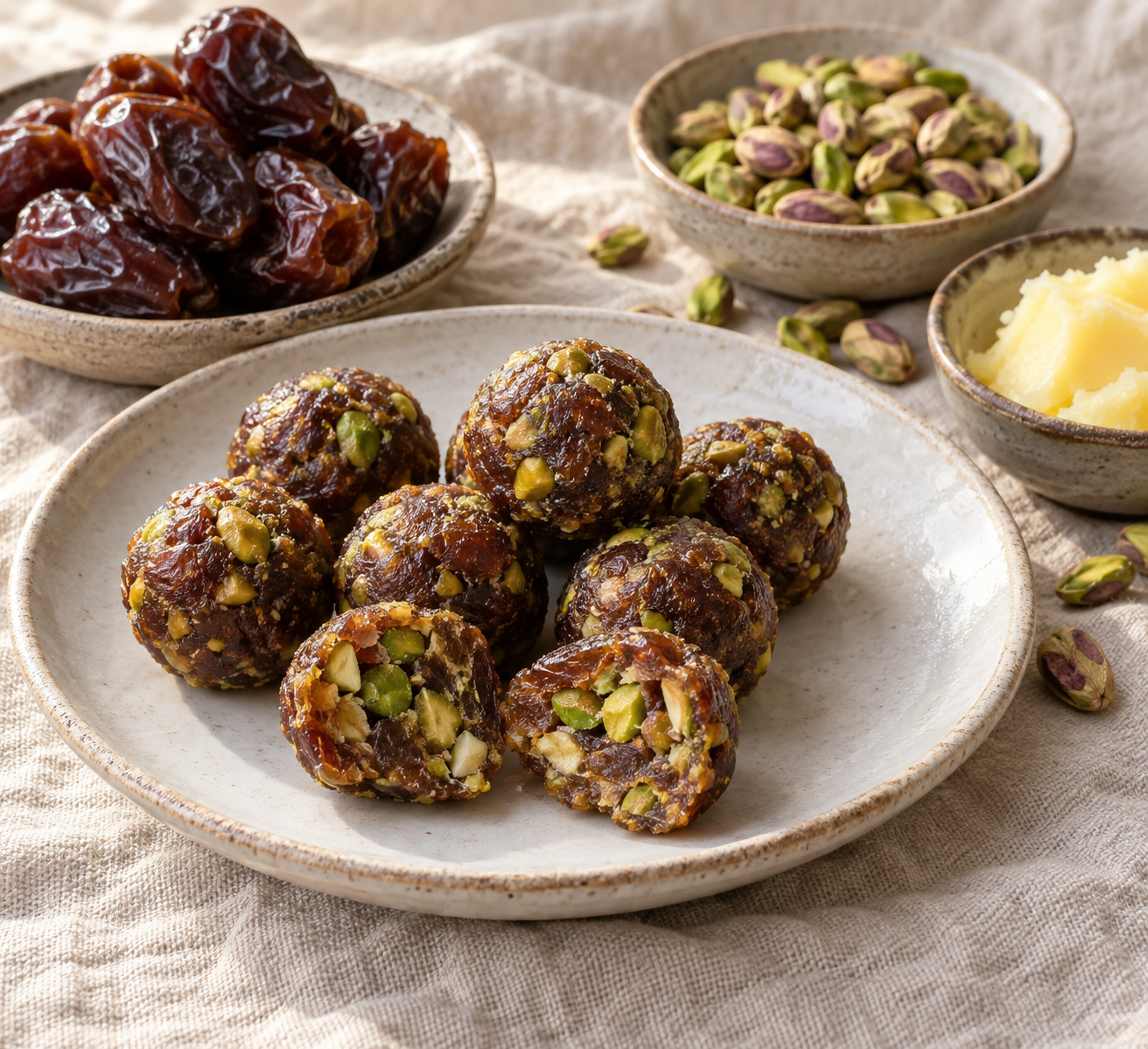
Date and pistachio mersu-inspired bites
Serves 6 · Preparation 20 min · Cooking 5 min · 20 minutes cooling and 30 minutes chilling
A modern adaptation for home cooking. Times are approximate.
Ingredients
- 250 g soft pitted dates, chopped
- 60 g shelled unsalted pistachios, roughly chopped
- 20 g pasteurized butter
- 2 tbsp water
- 1 pinch salt
Method
- Check dates carefully for pits. Put dates, water and butter in a small saucepan.
- Heat gently for 4–5 minutes, stirring and mashing until a thick paste forms. Add a teaspoon more water only if needed.
- Remove from heat; mix in 45 g pistachios and salt. Cool until comfortably handled, about 20 minutes.
- With clean slightly damp hands, form 12 small rounds. Press remaining pistachios onto them.
- Chill 30 minutes to firm up, then serve two per person.
Substitutions and adjustments
- Use almonds or walnuts if pistachios are unavailable; this changes the evidenced pairing.
- Olive oil can replace butter for a dairy-free modern adaptation.
Historical choices: Reconstruction based on an administrative association of dates and pistachios, not a surviving measured recipe. Shape and process are modern.
Kitchen note: Contains nuts. Check dates for hard pits; refrigerate covered.
Sources and further reading
- BAS: Mersu and the Mari delivery record. Explains the ingredient notice and absence of an exact ancient recipe.
- Harvard Museum: Ancient Mesopotamian Cuisine. Modern scholarly reception menu includes a date confection called mersu.


Comments
Post a Comment