Peas and Eggs: An Ancient Purée Served Cool
ANCIENT MEALS · 043 / 100
Late Roman cookbook tradition · Roman Mediterranean · Approximately 390–450 CE compilation, with earlier material
Evidence: adapted surviving recipe. The historical evidence and modern cooking choices are distinguished below.
The egg is part of the presentation
In a short recipe in Apicius, Book V, number 188 in Vehling's edition, cooked peas are worked into a purée and cooled while being stirred. Onion and chopped hard-boiled egg whites receive salt and vinegar, while yolks are passed through a sieve and finished with oil. These separate treatments create an unusually clear visual instruction: white pieces and golden crumbs contrast with a pea base.
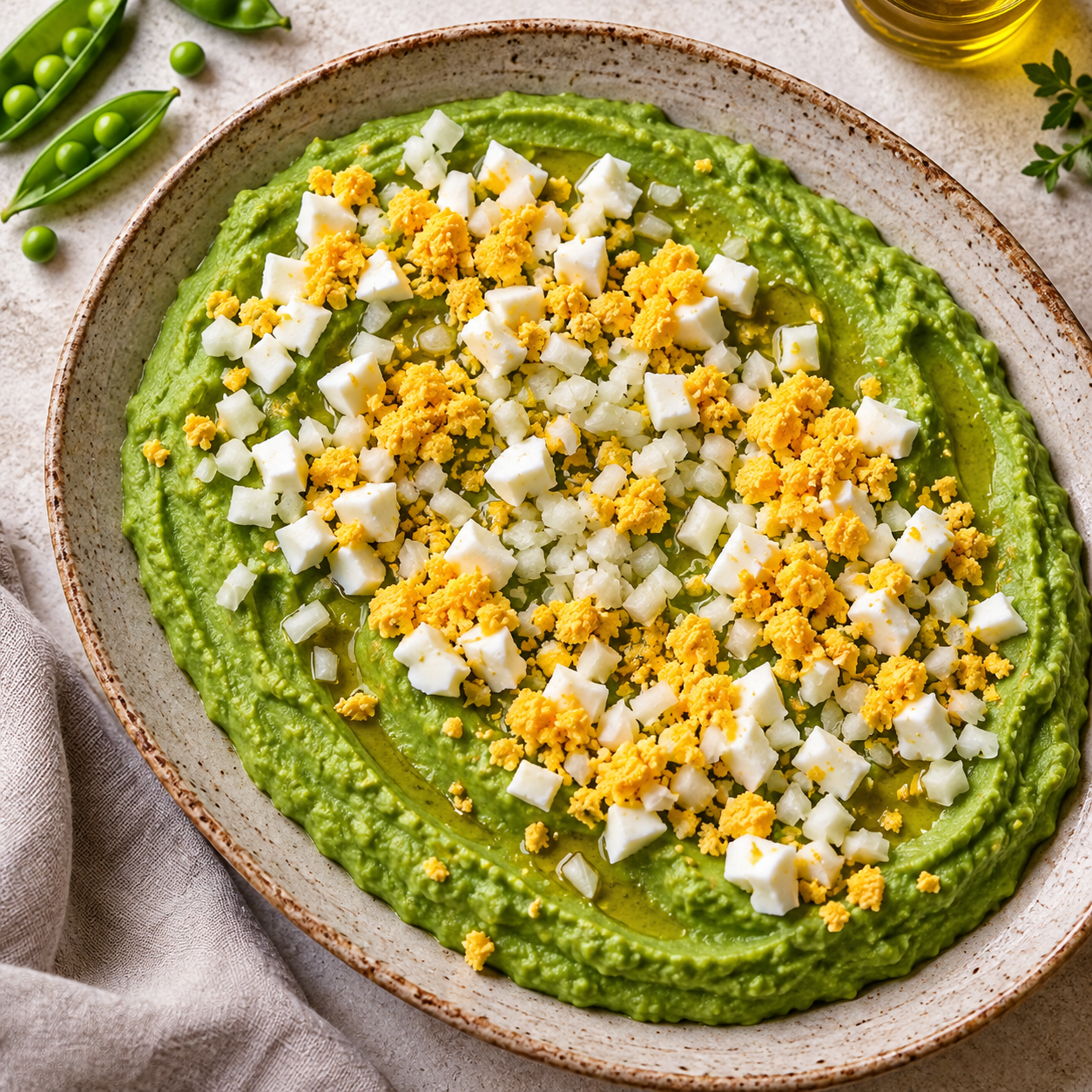
The text does not explain the final assembly as fully as a modern recipe would. The old English editor interprets the components as a dressing and draws contemporary comparisons. We keep the ingredients' separate textures but identify the layered plating as our practical decision. The Latin book allows readers to inspect the original short sequence. Its brevity is evidence of a working instruction, not permission to assume a hidden modern vinaigrette formula.
Dried peas, fresh peas, and uncertainty
The word for peas does not specify the precise product in a modern freezer or dried-goods aisle. Split dried peas make a stable purée and suit the instruction to work the legumes smooth, so they are chosen here. Frozen green peas are offered as a different, quicker interpretation. Their bright green colour should not be taken as proof that the ancient dish always looked that way. Cooking, crushing, and cooling can change its colour considerably.
This is a distinct cold legume-and-egg preparation, rather than another hot stew or egg custard. The eggs are already hard-boiled before mixing. Their role is to provide separate pieces and crumbs, not to bind a casserole. Vinegar gives the mild purée a sharpened finish, while the onion contributes crunch. Our quantity of onion is modest; its intensity can otherwise obscure the legumes and eggs.
Cooling in a modern kitchen
The recipe is situated in the late Roman compilation associated with Apicius, approximately fourth to fifth century CE, while individual instructions may preserve older practices. It does not establish a named festival, season, or social class for this particular dish. A modern refrigerator replaces any uncertainty about ambient cooling. Spread the purée shallowly so it cools quickly, then add the egg mixture shortly before service. Time depends on the dried peas, so cook to softness and add more water when necessary rather than forcing the stated minutes.
Cool pea purée with chopped egg dressing
Serves 4 side portions · Preparation 15 min · Cooking 45 min · Cool and refrigerate 30–60 minutes.
A modern adaptation for home cooking. Times are approximate.
Ingredients
- 180 g dried green split peas, rinsed
- 750 ml water, plus extra as needed
- 3 large eggs
- 2 tbsp finely chopped onion
- 1 tbsp wine vinegar
- 2 tbsp olive oil
- ½ tsp salt, divided
Method
- Simmer split peas in water for 35–50 minutes until very soft. Stir often near the end and add water to prevent scorching.
- Mash to a thick smooth purée and season with half the salt. Spread in a shallow container; cool briefly and refrigerate within two hours.
- Meanwhile cover eggs with cold water, bring to a boil, then simmer gently for 10 minutes. Cool in cold water and peel.
- Separate whites and yolks. Chop whites and combine with onion, vinegar, and remaining salt. Crumble or sieve the yolks separately.
- Spread chilled or cool purée on a serving dish. Add whites and onion, scatter yolks, drizzle oil, and serve.
Substitutions and adjustments
- Use 450 g frozen green peas, simmer 5–7 minutes, drain well, and mash for a quicker greener adaptation.
- Spring onion can replace a strongly flavoured bulb onion.
Historical choices: Apicius V records cooled pea puree and separate treatment of hard-boiled whites and yolks. Dried split peas, quantities, refrigerator cooling, and final plating are adaptations.
Kitchen note: Cool the purée and cooked eggs promptly; refrigerate until serving and return leftovers to refrigeration within two hours.
Sources and further reading
- Apicius, Book 5: English translation. Public-domain Vehling translation; editorial expansions and uncertain plant names require caution.
- Bibliotheca Augustana: Apicius, Latin Book 5. University-hosted primary Latin text used to check the recipe's ingredient and method framework.


Comments
Post a Comment