Libum: A Roman Cheese Loaf Baked on Leaves
ANCIENT MEALS · 035 / 100
Roman Republic · Italian peninsula · Approximately 160 BCE
Evidence: adapted surviving recipe. The historical evidence and modern cooking choices are distinguished below.
A loaf with cheese at its centre
Cut into libum and the surprise is how little it resembles a modern airy loaf. Cheese supplies much of its substance; flour holds the mixture together rather than becoming an elastic bread dough. In chapter 75 of Cato's On Agriculture, cheese is pounded, mixed with wheat flour and an egg, shaped, and baked on leaves beneath a heated cover. That concise instruction survives from Roman Italy in the second century BCE. It provides a real recipe, even though it leaves the modern cook to determine heat and baking time.
Cato offers two flour quantities, including a smaller amount for a finer result. The adaptation below chooses the firmer, easier-to-handle approach and reduces the scale to a household loaf. Drained ricotta supplies accessible fresh cheese. Its water content varies considerably, so the dough should be soft but able to hold a mound. An extra spoonful of flour can help a very wet batch; it is better to drain the cheese first than to turn the cake into ordinary bread.
Reading the hearth
A covered crock with heat around it functioned as a small baking chamber. Our oven reproduces the basic enclosed baking principle, without pretending to reproduce an ancient hearth's uneven heat. Bay leaves are a deliberate choice for Cato's unnamed leaves: aromatic foliage works well under the loaf, but the text of this particular recipe does not identify a species. They are removed before eating. There is no yeast or baking powder in the surviving instruction, and none is added here.
The British Museum's discussion of libum connects Roman cakes with household food and religious offerings, while showing how later readers adapt them. Those associations should not turn every cheese loaf into a documented festival menu. Cato's passage records a preparation, not the occasion on which this exact loaf was eaten. Honey, often added to modern versions, is absent from his libum instruction; this version keeps the loaf unsweetened.
A useful modern portion
Serve small wedges warm, when the cheese aroma is clearest, beside cooked vegetables or olives. Expect a close, moist crumb and a browned surface rather than the texture of a bakery roll. The quantities, oven setting, portion count, and food-safety endpoint below are modern decisions. Use the stated texture and doneness checks alongside the approximate time.
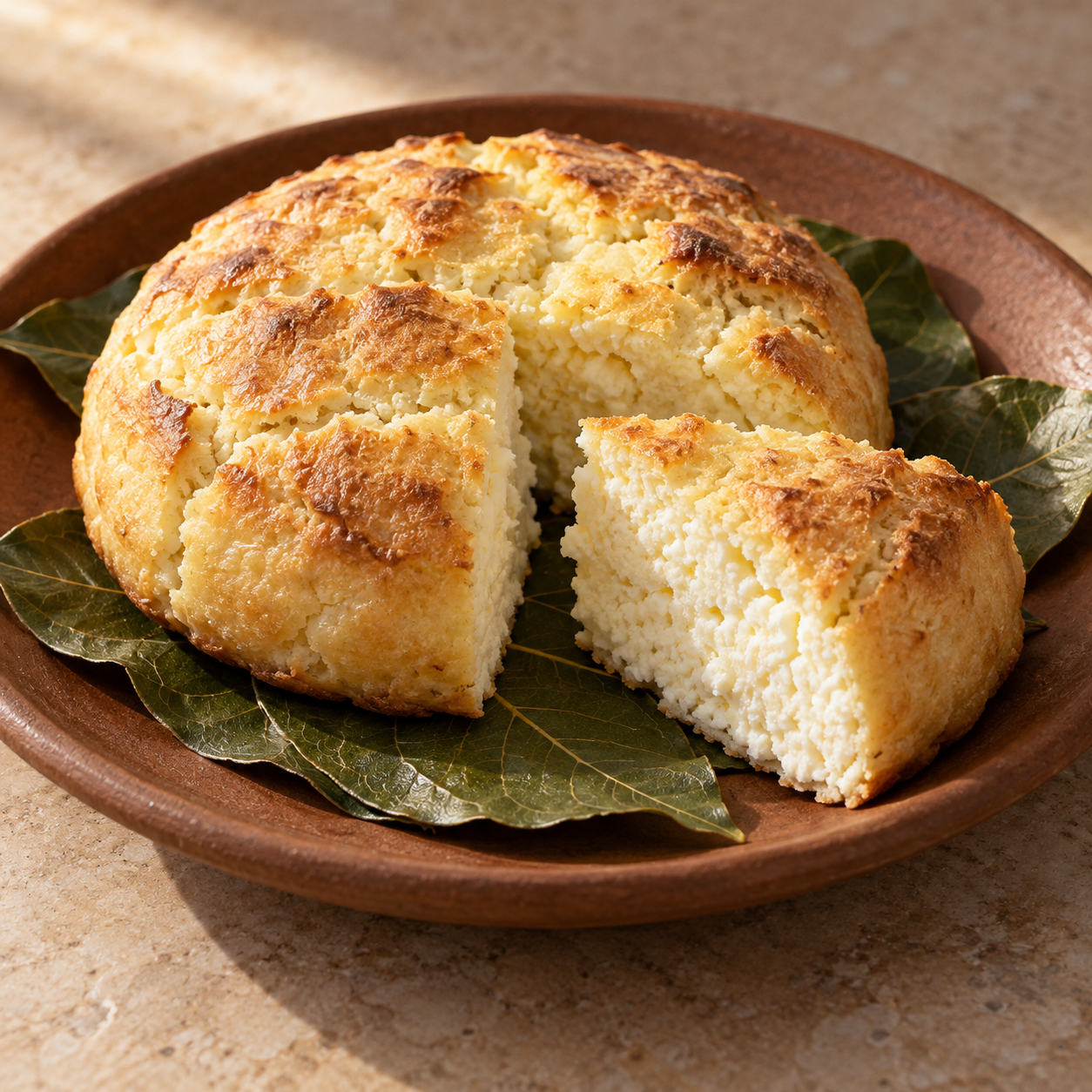
Leaf-baked fresh-cheese libum
Serves 6 small wedges · Preparation 15 min · Cooking 35 min · Drain ricotta for 30–60 minutes if watery; cool 10 minutes.
A modern adaptation for home cooking. Times are approximate.
Ingredients
- 300 g pasteurized ricotta, well drained
- 150 g (about 1¼ cups) plain wheat flour, plus up to 1 tbsp if needed
- 1 large egg
- 6 food-grade dried bay leaves
- 1 tsp olive oil
- ¼ tsp salt, only if cheese is unsalted
Method
- Heat the oven to 180°C/350°F. Line a baking tray and lightly oil a circle about 15 cm across; arrange the bay leaves on it.
- Mash the ricotta smooth. Mix in the flour, egg, and optional salt until a soft dough forms. Add at most 1 tbsp extra flour if it cannot hold a mound.
- Shape a low round loaf about 14 cm wide and 3 cm high over the leaves.
- Bake 30–40 minutes until the surface is golden, the centre is firm, and the egg-containing centre reaches 71°C/160°F. Cover loosely if the top colours too quickly.
- Rest 10 minutes. Remove the leaves, then cut into six wedges.
Substitutions and adjustments
- Use well-drained pasteurized fresh farmer's cheese instead of ricotta.
- A blend of 100 g plain flour and 50 g whole-wheat flour gives a firmer loaf; this is a modern flour choice.
Historical choices: Adapted from Cato 75. Cheese, wheat flour, egg, leaf support, and covered baking are attested; bay identification, modern quantities, and oven temperature are adaptations.
Kitchen note: Use pasteurized cheese and cook the egg mixture through. Bay leaves are aromatic supports, not an edible garnish.
Sources and further reading
- Cato, On Agriculture 74–90. Public-domain Loeb translation of the primary instructions; modern cooking quantities and heat are interpretive.
- British Museum: Cook a classical feast. Museum discussion of libum and later adaptations; its honeyed version is distinguished from Cato 75.


Comments
Post a Comment