Breadfruit and the Long History of Pacific Tree Foods
ANCIENT MEALS · 100 / 100
Lapita-era tree-food context · Western Melanesia and early Pacific exchange sphere · c. 1200–500 BCE; exact local introduction dates uncertain
Evidence: historically informed adaptation. The historical evidence and modern cooking choices are distinguished below.
A tree food needs a careful timeline
Breadfruit is central to many Pacific food traditions, but its history cannot be dated everywhere by looking at present-day gardens. Research reviewing breadfruit in Vanuatu discusses tree cultivation, regional diversity, and the uneven evidence for older practices. The first written descriptions are much later than Lapita settlement, so they cannot be copied backward as a precise ancient recipe.
A study of archaeological starch and plant movements summarizes the wider view that breadfruit was domesticated in Island Southeast Asia or western Melanesia and dispersed with people from early Lapita times. Its own excavated Rapa Nui evidence is later than this collection's scope; it is used here for that reviewed crop background, not to claim pre-700 CE breadfruit on Easter Island.
A fruit cooked as a starch
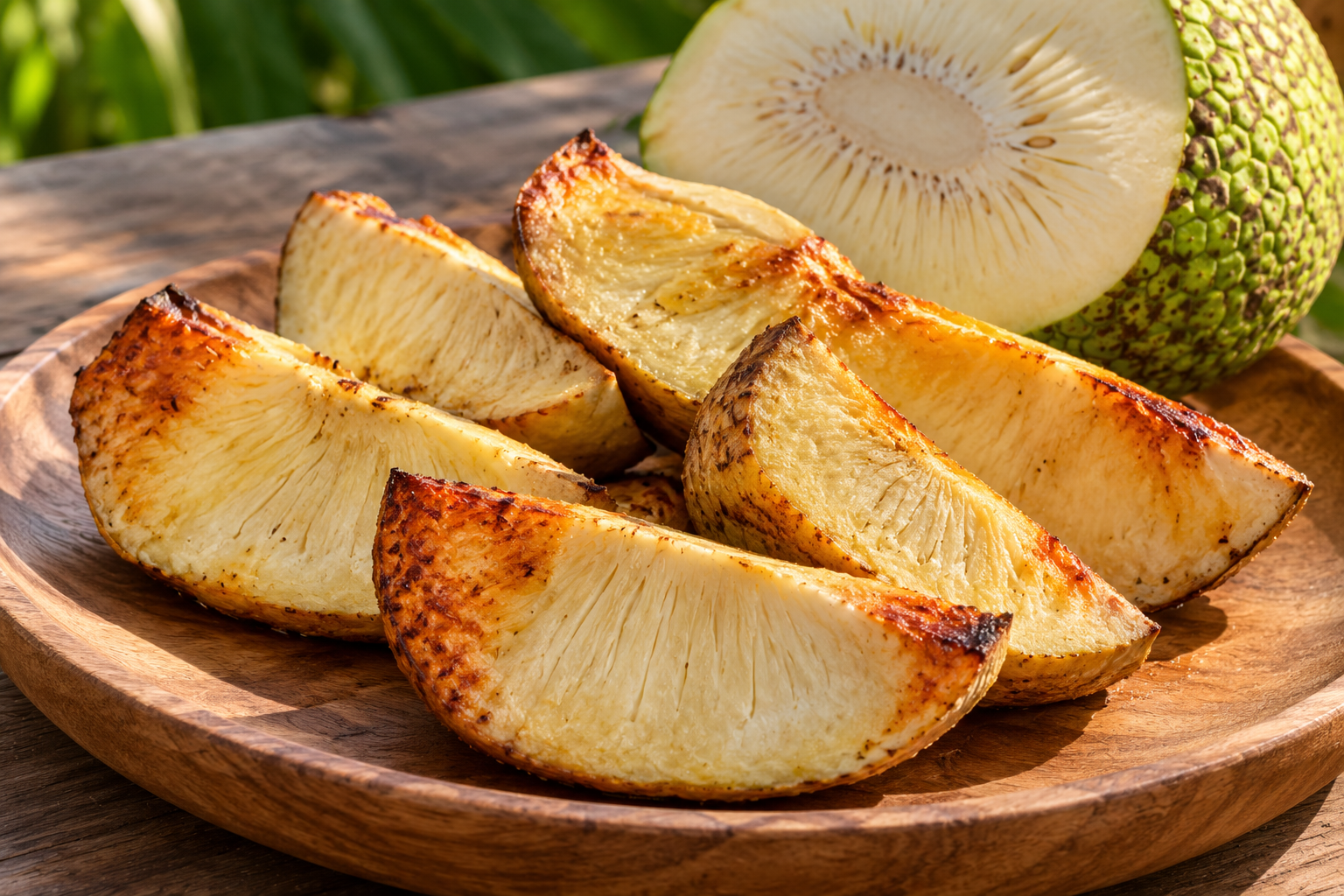
Commercial mature breadfruit has a starchy flesh useful for a savory meal. Our version parboils peeled wedges, drains them, brushes them with a little oil, and roasts them until the surfaces firm and brown. It is a dry wedge preparation rather than a coconut mash or leaf parcel. The modern oven and oil are openly part of the adaptation.
No surviving Lapita breadfruit recipe supplies these steps. Nor do we claim an exact introduction date for every island. Broad crop dispersal is a different proposition from identifying a particular household dish. A modern product can give us a safe edible starting point while the article keeps the historical timeline less tidy and more honest.
Growing a food is different from finding it
A productive tree has a longer relationship with a place than a pot of harvested seeds. Planting, protecting, and selecting useful trees can shape a food landscape over generations. Tree food may leave fewer obvious traces than a charred cereal assemblage, yet its cultivation can still matter to settlement and movement.
Serve the wedges hot, without an elaborate garnish, to notice their starchy interior and roasted surface. The historical anchor is breadfruit's early western Pacific cultivation and dispersal as discussed by researchers; exact local dates, proportions, parboiling, oil, and oven method are a modern interpretation. The uncertainty is part of the article's purpose. An ancient-food collection can include a valuable tree crop without pretending that a later documented preparation has a perfectly recoverable Lapita beginning.
Parboiled and roasted breadfruit wedges
Serves 4 · Preparation 20 min · Cooking 45 min · 5 minutes drying
A modern adaptation for home cooking. Times are approximate.
Ingredients
- 1 medium, yielding about 800 g prepared flesh commercial mature edible breadfruit
- 25 ml neutral cooking oil, modern adaptation
- 3 g salt, optional modern seasoning
Method
- Use mature food-grade breadfruit. Cut into quarters, remove core, peel, and cut into 2–3 cm wedges.
- Put wedges in boiling water and simmer 12–15 minutes until almost tender; drain and let dry 5 minutes.
- Heat oven to 210°C. Toss wedges with oil and optional salt and spread on a lined tray without crowding.
- Roast 25–30 minutes, turning once, until fully tender inside and browned on edges. Serve hot.
Substitutions and adjustments
- Use commercial frozen breadfruit wedges, following package guidance and labeling the processed ingredient.
- Potato is a practical modern substitute if breadfruit is unavailable, but it changes the defining plant and historical connection.
Historical choices: Inspired by the early western Pacific breadfruit crop history; the parboiled roast-wedge recipe is a modern adaptation, not a preserved Lapita formula.
Kitchen note: Use commercially sold edible breadfruit and cook fully. No home fermentation or historic preservation method is reproduced.
Sources and further reading
- Ethnobotany of Breadfruit in Vanuatu: Review and Prospects. Research review of tree cultivation and historical documentation; later preparations do not establish a Lapita recipe.
- Identification of breadfruit and crop movements through starch analysis. Peer-reviewed review of early breadfruit domestication/dispersal; the paper’s actual Rapa Nui evidence is later and is not projected before 700 CE.


Comments
Post a Comment